Episode 115 ~2:00 Standards EN · العربية

TM-15 BUG ratings, the spec behind Dark-Sky

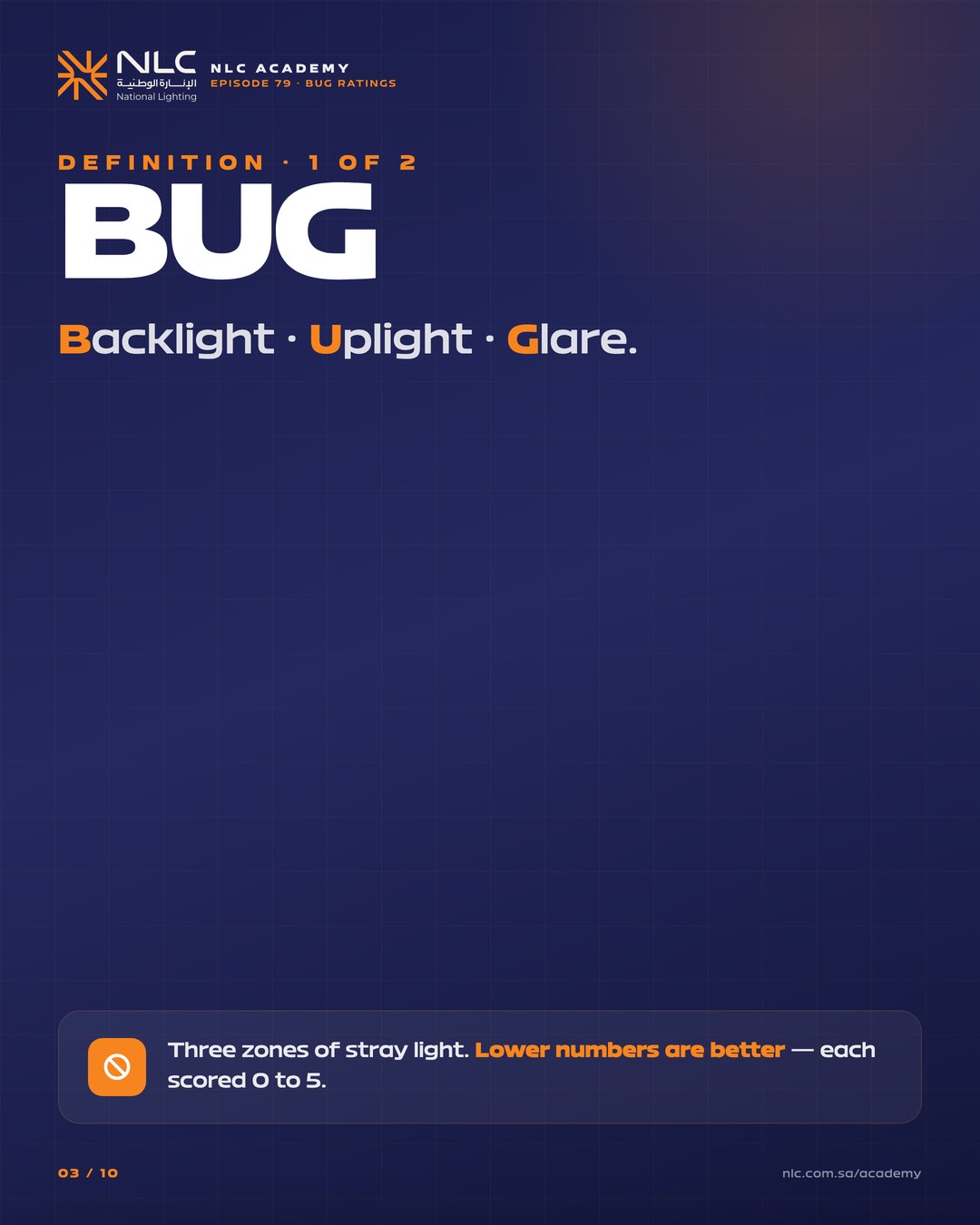
Dark-sky compliance used to be a vibe. TM-15 turned it into three numbers: Backlight (light spilling behind), Uplight (light going skyward), Glare (light at high angles). Every outdoor fixture sold today carries a B0-B5 / U0-U5 / G0-G5 rating, and AlUla, NEOM, and most KSA municipalities now write LZ-class limits directly into the BOQ.

Animated explainer, press play to watch the concepts now; the filmed cut publishes once production wraps.

What you'll walk away with

Four ideas that move dark-sky from philosophy to a spec line.

01

BUG is three numbers, not one.

Backlight, Uplight, Glare, scored independently 0–5 each. A spec saying "U0 only" is fine for Dark-Sky compliance but says nothing about glare onto neighbours' bedroom windows.

02

LZ classes pick the limit.

LZ0 (intrinsic dark, AlUla observatories) caps B1/U0/G1. LZ4 (high-activity city centre) allows B5/U4/G5. The site, not the fixture, decides the budget.

03

U0 forbids any uplight at all.

Zero lumens above 90°. Requires sharp horizontal cut-off optics, not just "full cut-off" marketing. KSA observatory and protected-area projects mandate U0.

04

The IES file already has it.

Modern IES TM-15 files include zonal lumen output by solid angle. AGi32, DIALux, and Visual all auto-compute the BUG rating, no separate report needed.

Lighting Zone (LZ) × max BUG allowed

Per IES TM-15 / MLO 2011. KSA municipalities map LZ to land-use zoning.

ZoneDescriptionMax B / U / GExample KSA
LZ0Intrinsic darkB1 / U0 / G1AlUla observatories
LZ1Rural / wildernessB2 / U1 / G2Resort developments
LZ2Low-density residentialB3 / U2 / G3Suburban Riyadh
LZ3Medium activity / commercialB4 / U3 / G4Mixed-use districts
LZ4High-activity city coreB5 / U4 / G5Downtown Riyadh
NEOM dark zoneReserve adjacencyB1 / U0 / G1NEOM IDA-class areas

How TM-15 actually scores a fixture

Six ideas behind every "this fixture is B2-U0-G2" line on a datasheet.

The sphere is divided into zones.

TM-15 carves the sphere around the luminaire into named angular zones, FL, BL, BH, BVH, UH, UL, FVH, BVH. Each captures lumens in a specific direction (forward, back, low, high, very high). The rating is the worst zone score.

Uplight is scored 0–5 by absolute lumens.

U0 = zero lumens above 90°. U1 ≤ 10 lm. U5 = no limit. Uplight values do not scale with fixture size, they are absolute, which is why a single bad uplight luminaire in a U0 project fails the entire site audit.

Backlight is scored relative to fixture lumens.

BL and BH zones sum the lumens going backward at low and high angles. The score is then mapped to a ratio against forward output. B0 fixtures are essentially asymmetric, throwing 95%+ forward.

Glare is the high-angle output toward observers.

G-score caps the lumens in the FVH + BVH zones (60–90° from nadir), the angles that hit people's eyes when standing or driving past. Full-cut-off fixtures land G0-G2. Old wallpacks and acorn fixtures with exposed lamps land G4-G5.

House-side shielding is a free letter grade.

A drop-in house-side shield on a road luminaire takes BL from B3 to B1 with zero photometric redesign. KSA tenders writing "B1 max, BL house-side shield required" get the trespass control they want at modest extra cost.

"Dark-Sky approved" is not BUG.

The IDA Fixture Seal of Approval predates TM-15 and only checks U0. A U0 fixture can still have B5/G5 and ruin a neighbour's bedroom. Specify BUG explicitly: "U0 + B≤2 + G≤2 per IES TM-15" closes both gaps in one line.

Forward the carousel to a colleague

A 10-slide explainer, ready to post straight to LinkedIn as an image carousel. Same content, faster reading.
Next Episode

Stroboscopic Effect & SVM

Watch next

Get the next episode by email

Practical lighting know-how from NLC Academy. No spam, unsubscribe anytime.

By subscribing you agree to receive NLC emails.