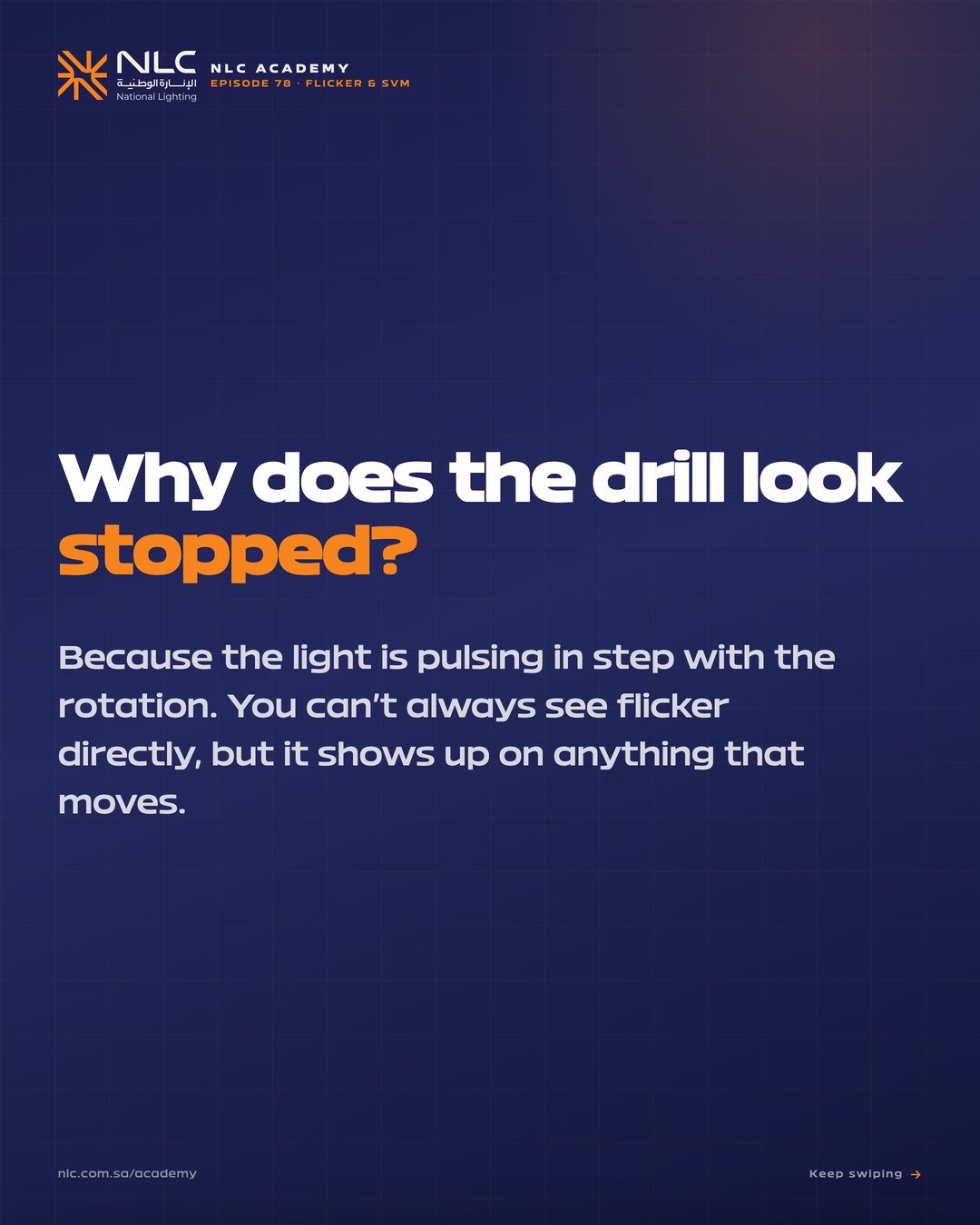
Flicker percentage and flicker index missed a whole class of visible artefacts: dotted patterns on moving objects, freeze-frames on fan blades, jitter on phone-camera video. Two newer metrics, SVM (CIE TN 006) and Pst LM (CIE TN 008), catch those. Since EU 2019/2020 they are the legal limit for LED products entering the European market, and increasingly KSA premium projects mirror them.
Four ideas that explain why flicker% is no longer the right number.
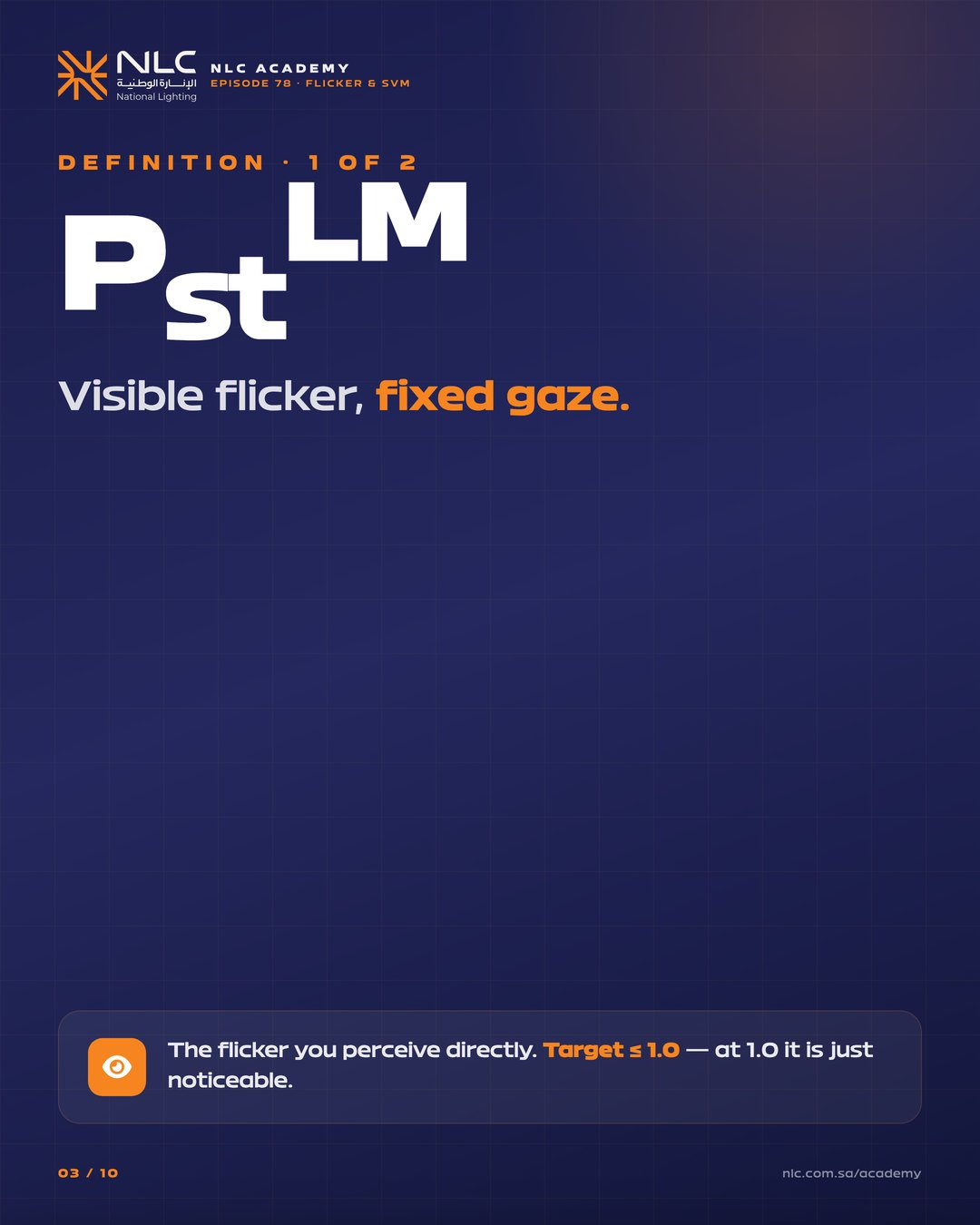
0.1–80 Hz range. Perceived as visible blink. Limit: Pst LM ≤ 1.0 per EU 2019/2020.
80–2000 Hz range. Not consciously seen, but causes stroboscopic artefacts on moving objects. Limit: SVM ≤ 0.4.
Cheap drivers with shallow output filtering have 100 Hz / 120 Hz ripple that prints visible patterns. Premium drivers buffer the ripple with bulk capacitance and tight regulation.
Drivers dimming via PWM below 1 kHz print SVM > 1 at low dim levels. Specify "≥ 3 kHz PWM" or "amplitude-dimming above 10%" to avoid it.
EU Ecodesign 2019/2020 limits, applicable to all LED light sources sold in EU since Sept 2021.
| Metric | Frequency range | Threshold | What it catches |
|---|---|---|---|
| Pst LM | 0.1–80 Hz | ≤ 1.0 | Visible blink / fade |
| SVM | 80–2000 Hz | ≤ 0.4 | Stroboscopic / phantom |
| Flicker % | DC + ripple | historical | Old metric, deprecated |
| Flicker index | DC + ripple | historical | Old metric, deprecated |
| IEEE 1789 (low risk) | f > 90 Hz | Mod% < 0.08 × f | Health guidance |
| NEMA 77-2017 | composite | Application-tiered | US specifier tool |
Six ideas behind the new temporal-light-modulation standards.
Flicker (visible blink) and stroboscopic effect (motion artefact) are processed by different parts of the visual system. A lamp can pass flicker% and still produce strobing patterns at 120 Hz that the brain processes subconsciously, raising eye strain and headaches over an 8-hour shift.
The SVM (Stroboscopic Visibility Measure) calculation FFTs the luminance waveform, weighs each frequency component by an empirical sensitivity curve, and combines them via a Minkowski-norm sum. SVM = 1.0 means a typical observer just notices a stroboscopic artefact on a moving target. ≤ 0.4 is "imperceptible."
The slow-end metric reuses the IEC flickermeter model originally built for power-grid flicker, applied to the modulating light output. Pst = 1.0 corresponds to perceptibility threshold.
LEDs respond to current with sub-microsecond fidelity. Anything modulating the current, mains ripple, PWM dimming, poor PFC, prints onto the light output. Always measure SVM with the driver and the LED together, not just the chip.
A driver that hits SVM 0.1 at full output can blow past 1.0 at 5% dim if the PWM frequency is below 1 kHz. Premium drivers run PWM at 3–8 kHz, or use hybrid amplitude + PWM dimming, or pure constant-current amplitude dimming.
Saudi SASO doesn't yet mandate SVM. But premium Vision-2030 projects, NEOM, Diriyah, Qiddiya, AlUla resort, write SVM ≤ 0.4 and Pst LM ≤ 1.0 into the BOQ, and reject products that cannot produce LM-90 / TM-33 test reports. Specifying it is now standard practice.
Every NLC premium luminaire ships with SVM and Pst LM test reports per CIE TN 006 / TN 008, traceable to TM-33 measurement methodology.
A 10-slide explainer, ready to post straight to LinkedIn as an image carousel. Same content, faster reading.
10 slides · LinkedIn-ready. Download all 10 as high-res PNGs and post them straight to LinkedIn as a carousel. PDF version still available.
Practical lighting know-how from NLC Academy. No spam, unsubscribe anytime.
By subscribing you agree to receive NLC emails.