More lumens doesn't mean better light. In 110 seconds, the difference between what a fixture produces and what actually arrives on the surface you care about, and the four numbers worth memorising.
Four ideas to carry into the next lighting conversation you have.
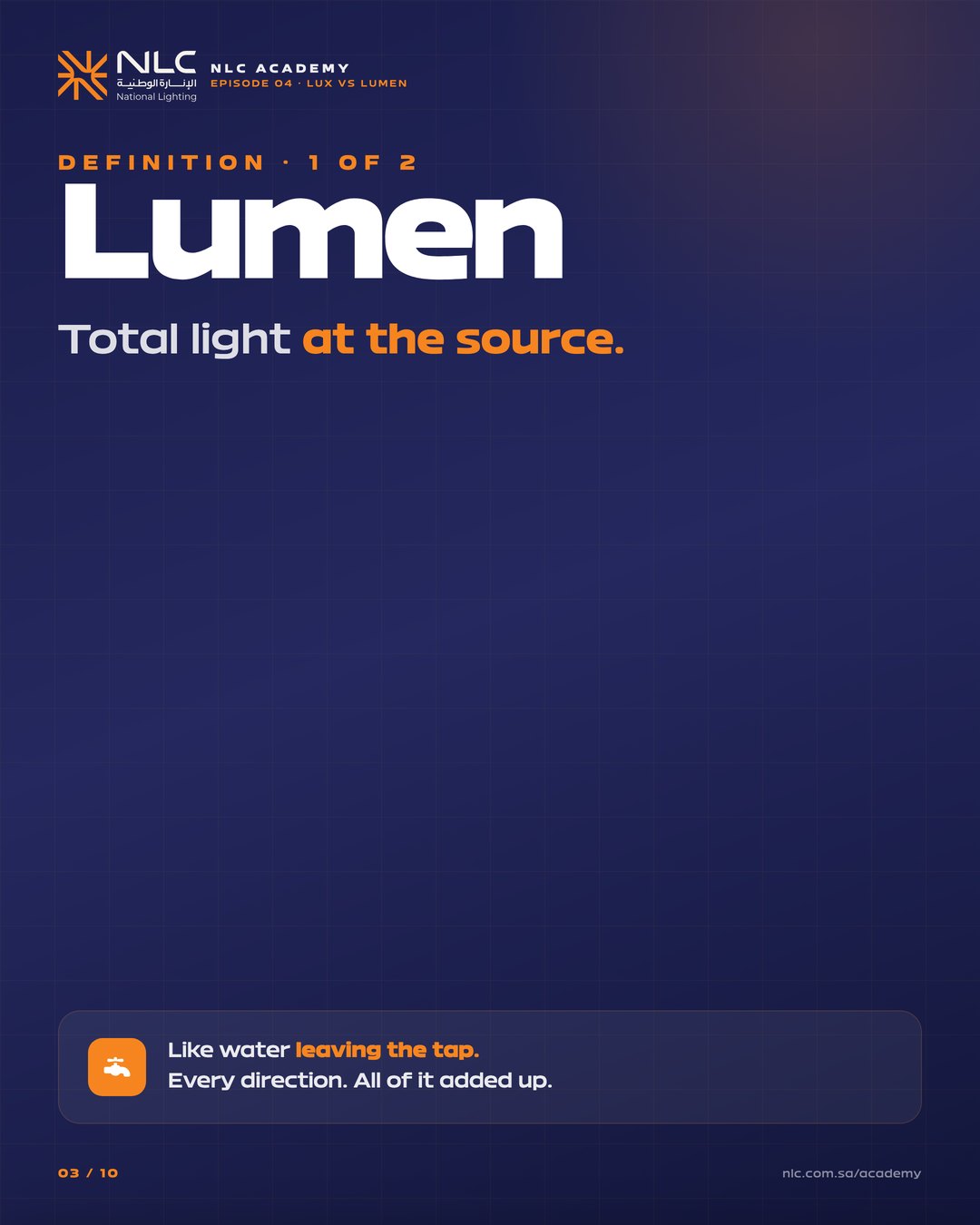
Lumens measure total light leaving the fixture. Lux measures how much of it lands on the surface you actually care about, per square metre.
Mounting height, beam angle, and reflector choice all change how 1,000 lumens become 100, or 400, lux on the floor.
Real designs target lux on the desk, corridor floor, or workbench, not headline lumen numbers.
A complete spec sheet lists both lumen output and the photometric (.ies / .ldt) file. If it doesn't, ask why.
Illustrative values. Final design depends on task, occupant age, and surface reflectance, but these are the conversations to start from.
| Space | Target lux | Reference |
|---|---|---|
| Corridor / general circulation | 100 lux | EN 12464-1 · Table 5.1 |
| Office desk / workspace | 500 lux | EN 12464-1 · Table 5.26 |
| Warehouse aisle (manual) | 200 lux | EN 12464-1 · Table 5.50 |
| Retail focal / display | 750 lux+ | EN 12464-1 · IES RP-3 |
| Hospital ward (general) | 100 lux | EN 12464-1 · Table 5.46 |
| Hospital examination | 1,000 lux | EN 12464-1 · Table 5.46 |
A 10-slide explainer, ready to post straight to LinkedIn as an image carousel. Same content, faster reading.

10 slides · LinkedIn-ready. Download all 10 as high-res PNGs and post them straight to LinkedIn as a carousel. PDF version still available.
Captions for accessibility, plus a record of every claim with the EN 12464-1 numbers traceable.
More lumens doesn't mean better light. Let me show you why.
Start with the lumen. A lumen measures the total light coming out of the fixture, every direction, all of it added up. It's the light at the source. Like water leaving a tap.
Lux is different. Lux is what actually lands, light per square metre on the surface you care about. The desk. The corridor floor. The product on the shelf. Same tap, different bucket.
Here's where people get caught out. Take a thousand-lumen downlight. Mount it at three metres, you might get 400 lux on the floor. Move it to six metres, about 100. Swap the reflector for a wider beam, different number again. Same lumens. Three completely different lux outcomes.
So when you're specifying a space, you're not buying lumens, you're designing for lux on the work plane. A corridor needs about a hundred lux. An office desk needs five hundred. A warehouse aisle, two hundred. Retail focal, seven-fifty and up.
The common mistake, buying by lumens on the box and hoping for the best. You end up with glare on the ceiling and not enough light where the work actually happens.
Every NLC datasheet lists both, lumen output and the photometric file. Our DIALux service models lux on your actual work plane before anything ships. That's the work that turns a fixture into a design.
Next episode, choosing the right reflector. Because the reflector is where lumens become lux.
Practical lighting know-how from NLC Academy. No spam, unsubscribe anytime.
By subscribing you agree to receive NLC emails.