Solder-paste printing, pick-and-place, reflow, AOI, ICT, the five-station SMT line is the backbone of every modern LED fixture. What each station does, and what the inspection report should show.
Four ideas to carry into the next specification conversation you have.
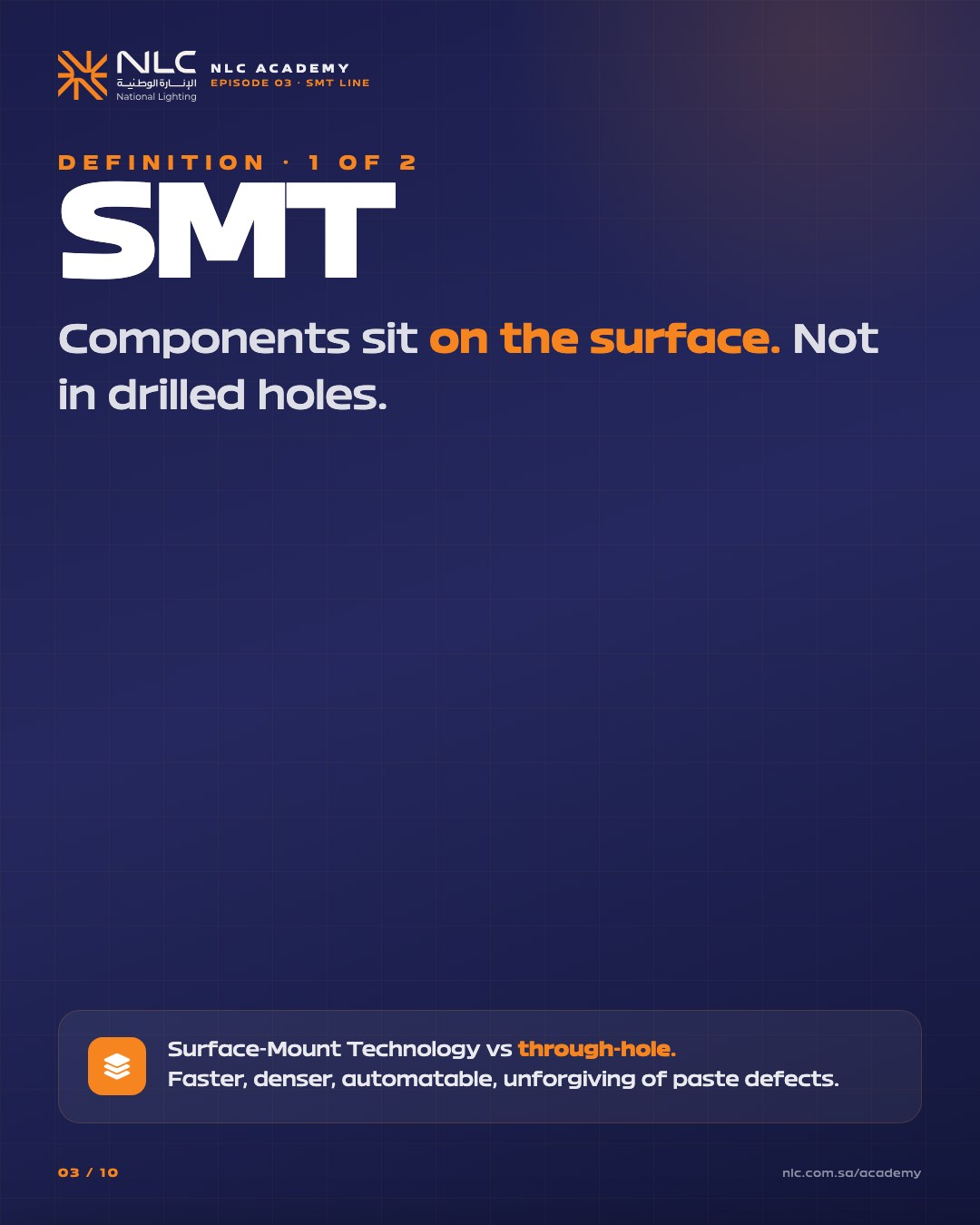
Components sit on the PCB surface, not through holes. Faster, denser, automatable, and unforgiving of paste defects.
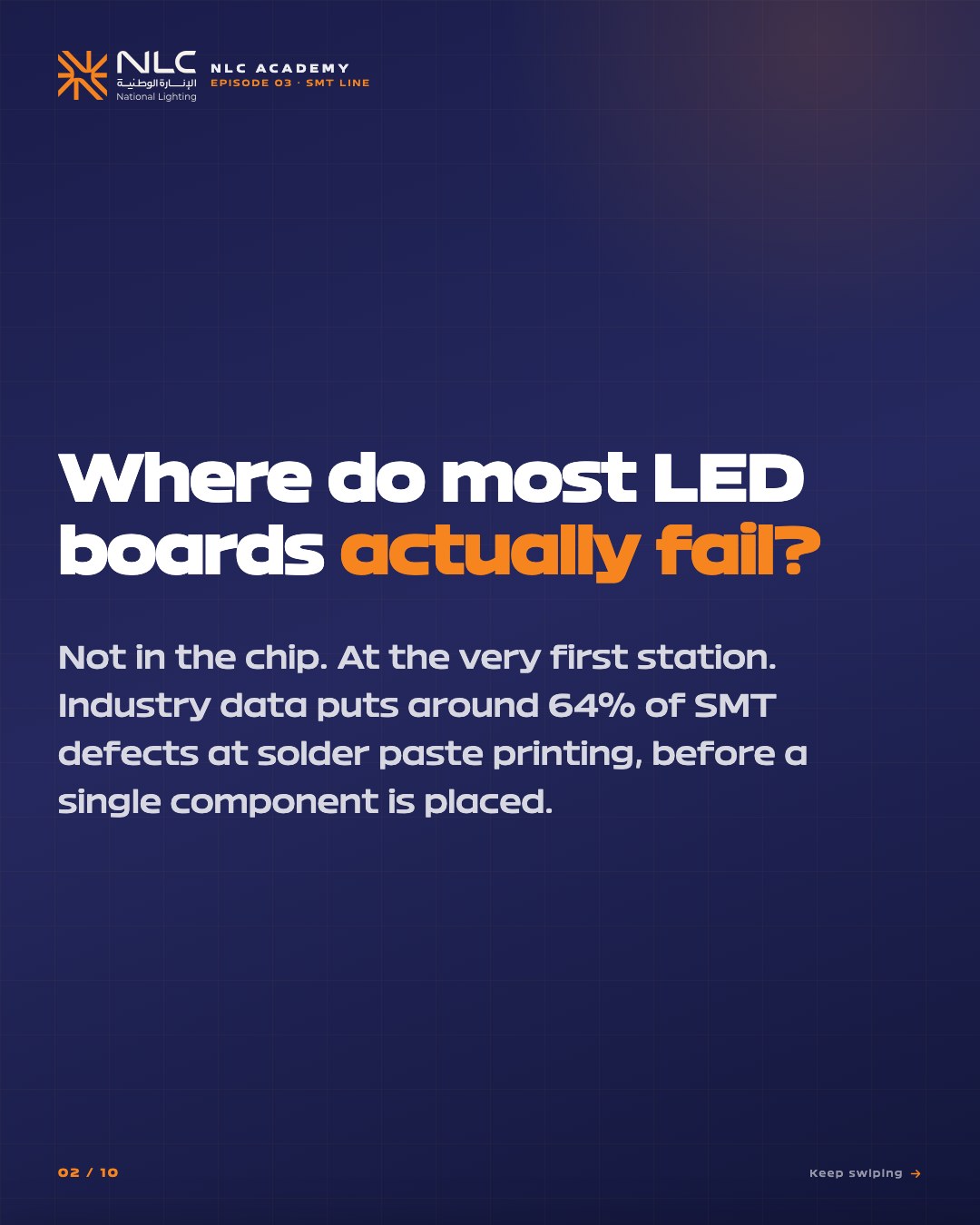
Industry data: ~64% of SMT failures start at the stencil. Volume, alignment, and shape of the deposit decide the joint.
Preheat → soak → reflow peak → cooldown. The curve is tuned to the paste alloy (SAC305 ≈ 245 °C peak). Wrong curve = cold joints or chip damage.
Automated Optical Inspection scans every board at high resolution. Missing parts, tombstones, solder bridges, flagged before the board ever ships.
Cycle time per station typical for fine-pitch LED boards. Your numbers depend on board size and pick count.
| Station | What happens | Typical QA gate |
|---|---|---|
| Solder paste print | Stencil deposits paste pads | SPI volume ±10% |
| Pick & place | Robot places resistors, LEDs, ICs | Vision: rotation < 5° |
| Reflow oven | Heat profile melts paste, forms joints | Thermocouple log on every batch |
| AOI | Camera inspects every joint | Zero criticals, ≤ 50 ppm minor |
| ICT / Flying probe | Electrical test of net continuity | 100% test or AQL 0.65 |
| Functional test | Power on, measure light output | Lumen ±5%, CCT ±100 K |
Five differences that explain price gaps between LED boards.
A pre-reflow SPI station scans every printed pad in 3D. Volume, height, area, alignment, out-of-spec deposits are flagged and the board reprinted. Without SPI, defects only appear at AOI, where rework is 5–10× more expensive.
Nitrogen-atmosphere reflow displaces oxygen during melt. Solder joints come out brighter, with less oxidation, fewer voids in the joint. Mandatory for high-reliability LED applications (transit, marine, medical).
Ball-grid arrays and high-current MOSFETs have joints under the body, invisible to AOI. X-ray inspection looks through the part to verify void content < 25% and joint geometry. We use this on every driver board.
LEDs and ICs ship in moisture-barrier bags with humidity indicators. Once opened, the floor-life clock runs. Premium lines store opened reels in dry cabinets at < 5% RH. Cheap lines do not, and the LEDs pop during reflow.
A modern SMT line records reel ID, operator, machine, reflow profile and AOI image for every board. Years later, a field failure can be traced to a single lot of capacitors. Insist on traceability in your contract.
Our SMT line in Dammam runs SPI, nitrogen reflow, full AOI and 100% functional test on every fixture leaving the plant.
A 10-slide explainer, ready to post straight to LinkedIn as an image carousel. Same content, faster reading.
10 slides · LinkedIn-ready. Download all 10 as high-res PNGs and post them straight to LinkedIn as a carousel. PDF version still available.
Practical lighting know-how from NLC Academy. No spam, unsubscribe anytime.
By subscribing you agree to receive NLC emails.