Same wattage, different chip, different result. A tour through SMD package geometry, the binning system that sorts chips at the fab, and how to spec a chip that performs the same in lot one and lot fifty.
Four ideas to carry into the next specification conversation you have.
2835 = small, cheap, ≤ 0.5 W. 3030 = mid-power workhorse. 5050 = three chips in one. COB = high-density, smooth optical source.
Flux (lumens), CCT (white-point), and CRI. A '6-step MacAdam ellipse' is loose; a '2-step' is tight. Lots without binning shift over time.
Two chips of the same bin can have Vf differing by ±5%. The driver must accommodate. A constant-current driver does; a constant-voltage one fights it.
Write 'Lumileds LM301H / Samsung LM301B / Osram Oslon', not '0.2 W LED'. Names lock the binning regime.
Before the binning and the packages, there is chemistry. The material stack is the first reason two same-watt chips give different light.
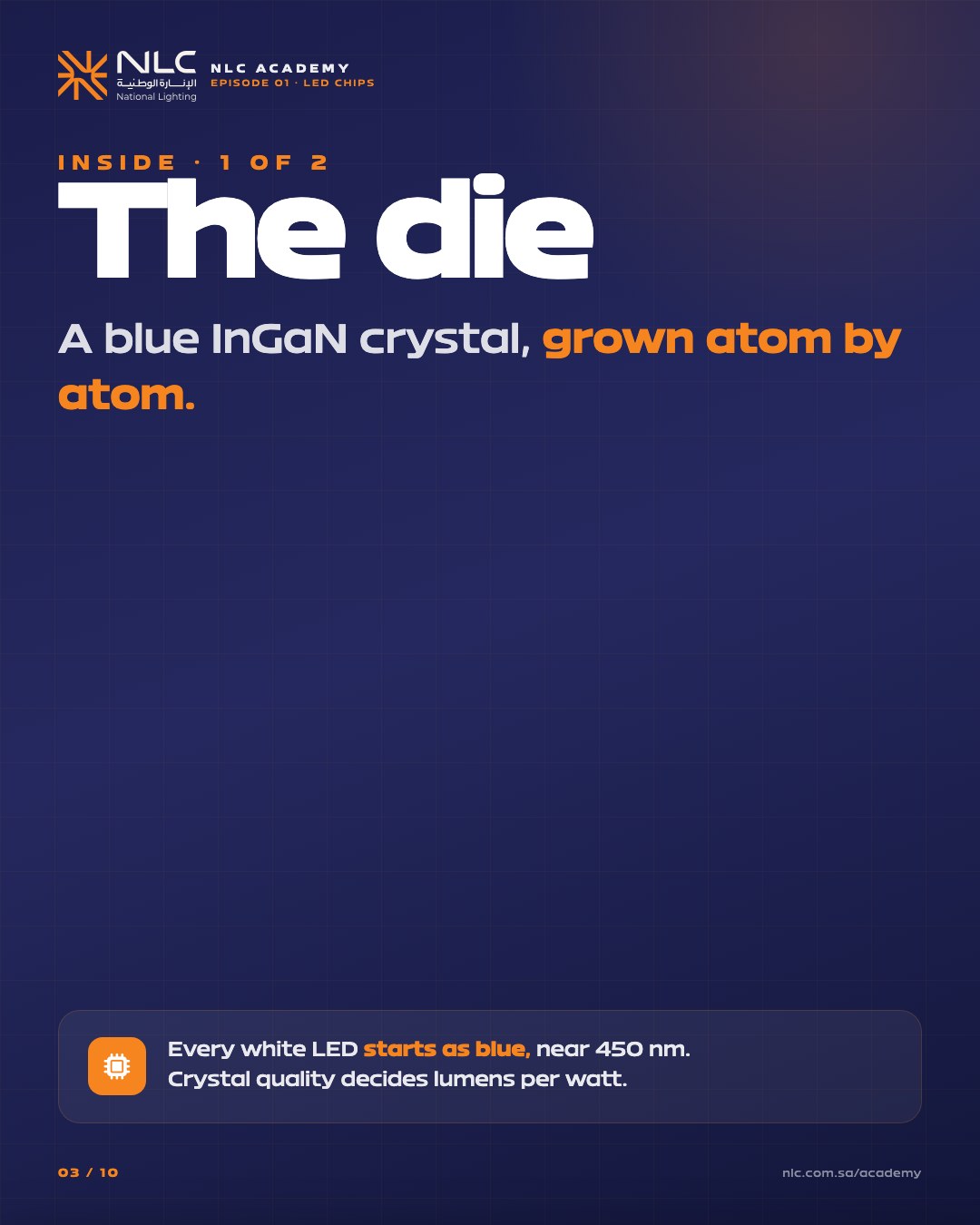
Every white LED starts as a blue one. Thin layers of indium gallium nitride (InGaN) are grown on a sapphire or silicon-carbide wafer by MOCVD epitaxy. When current crosses the InGaN quantum wells they emit blue light near 450 nm. The indium fraction sets the wavelength, more indium shifts it toward green, and crystal quality decides how much current becomes light. Two "identical" 1 W chips with different InGaN quality give different lumens at the same watt.
There is no white junction. White is made by coating the blue chip with a phosphor, classically cerium-doped yttrium aluminium garnet (YAG:Ce), which absorbs part of the blue and re-emits a broad yellow. Leaked blue plus that yellow reads as white. The phosphor recipe is the chemistry that sets CCT and CRI: more phosphor, plus added red nitride or fluoride phosphors (CASN, KSF), pulls the white warmer and lifts CRI. Same blue chip, different phosphor blend, a completely different white.
The deep-red and amber emitters in RGB and tunable fixtures are not InGaN at all, they are aluminium indium gallium phosphide (AlInGaP). It loses output with heat faster than the blue InGaN chips beside it, which is why a poorly matched RGBW module drifts in colour as it warms up. Knowing which chemistry sits behind each colour is how you predict how a fixture will look in year five.
Typical numbers, real values depend on bin and current. Cite the manufacturer datasheet for design.
| Package | Typical drive · efficacy | Use case |
|---|---|---|
| 2835 | 60 mA · ≈ 180 lm/W | Linear bars · panels |
| 3030 | 120 mA · ≈ 170 lm/W | Streetlight modules · highbay |
| 5050 (3-in-1) | 60 mA × 3 · 150 lm/W | RGB · tunable white |
| 3535 (high-power) | 350 mA · ≈ 160 lm/W | Spot · stadium |
| COB (chip-on-board) | 0.5–2 A · ≈ 150 lm/W | Downlight · gallery |
| CSP (chip-scale package) | 1–3 A · ≈ 200 lm/W | Compact spot · flash |
Five lines you should never sign off on without checking.
Major makers (Lumileds, Samsung, Osram, Cree, Nichia) print a bin code like "LM301H J5", the J5 names the flux × CCT × CRI bucket. Two chips with the same model and different bin codes will look measurably different on the wall.
A MacAdam ellipse describes how far a chip's white point can sit from the nominal CCT. 2-step is invisible to the eye; 5-step is the limit of "matched" for a uniform installation. Always spec 3-step or tighter for premium projects.
Within a single bin, lumen output can vary ±5%. Across adjacent bins, ±15% is normal. If your driver is set for one bin but the chip-maker ships an adjacent one, your lux drops without anyone noticing, until commissioning.
Vf bins (e.g., V1, V2, V3) describe the voltage at the rated current. A multi-chip module that mixes Vf bins burns the lower-Vf chips harder. Reputable assemblers sort to a single Vf bin per fixture.
An LED is a current device. A 1 W chip driven at 350 mA gives different lumens than a 1 W chip driven at 700 mA, even though wattage matches. The datasheet's drive-current curve is the truth, wattage alone lies.
Every fixture we sell lists the chip family and bin code in the BOM. No anonymous LEDs. No silent lot-to-lot shift.
A 10-slide explainer, ready to post straight to LinkedIn as an image carousel. Same content, faster reading.
10 slides · LinkedIn-ready. Download all 10 as high-res PNGs and post them straight to LinkedIn as a carousel. PDF version still available.
Practical lighting know-how from NLC Academy. No spam, unsubscribe anytime.
By subscribing you agree to receive NLC emails.