Episode 121 ~2:20 Mobility EN · العربية

EV charging infrastructure, the Vision-2030 power stack

EVIQ targets 5,000 fast chargers across KSA by 2030. Each one is a panel-bus-cable-charger-software stack with its own thermal, demand, communication, and revenue constraints. AC Mode 3 for destination, DC fast charge for highway, CCS Combo 2 for connector, OCPP for back-office. Here is what to specify.

Animated explainer, press play to watch the concepts now; the filmed cut publishes once production wraps.

What you'll walk away with

Four ideas that turn an EV-charging RFP into a deliverable spec.

01

AC is for parked cars. DC is for moving cars.

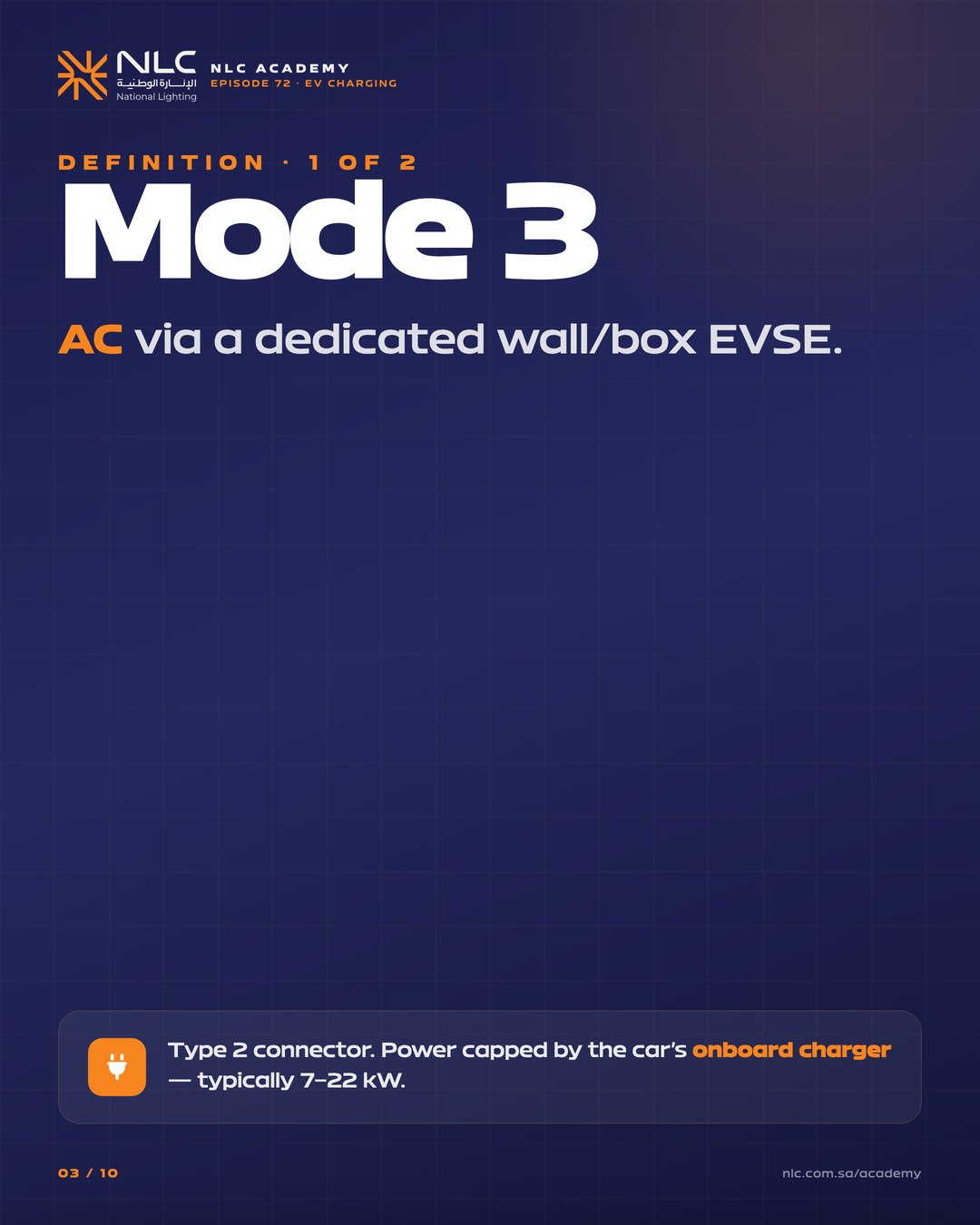
AC Mode 3 (3.7–22 kW) fits residential and destination workplaces, 4–8 hour charge. DC fast charge (50–350 kW) fits highway and forecourt, 20–40 minute charge.

02

CCS Combo 2 is the GCC standard.

The Type 2 (Mennekes) AC connector with two extra DC pins. One inlet, AC or DC, the connector standard KSA EVIQ and most EU OEMs have settled on.

03

Load management is half the design.

Ten 22 kW chargers running simultaneously is 220 kW. Without dynamic load management, your transformer trips. OCPP-driven shedding allocates available capacity to active sessions.

04

OCPP makes the charger talk to the network.

Open Charge Point Protocol (now 2.0.1) is the open API every charger speaks to its back-office. RFID, payment, remote start/stop, fault alerts. Specifying "OCPP 2.0.1 compatible" avoids vendor lock-in.

Charger type × power × time × use

Indicative figures for a 60 kWh BEV battery, KSA grid 415/240 V three-phase.

ChargerPowerConnector10–80% timeUse case
AC Mode 2 (portable)2.3 kWDomestic 13 A15+ hTrickle / emergency
AC Mode 3 single-phase7.4 kWType 27 hHome / villa
AC Mode 3 three-phase11–22 kWType 22–4 hDestination / workplace
DC fast50 kWCCS Combo 245 minForecourt / urban
DC high-power150 kWCCS Combo 220 minHighway corridor
DC ultra-high350 kWCCS Combo 2 (HPC)12 minHighway hubs / EVIQ super

How an EV charging site actually gets built

Six engineering decisions behind every commercial charging deployment.

AC and DC live in different worlds.

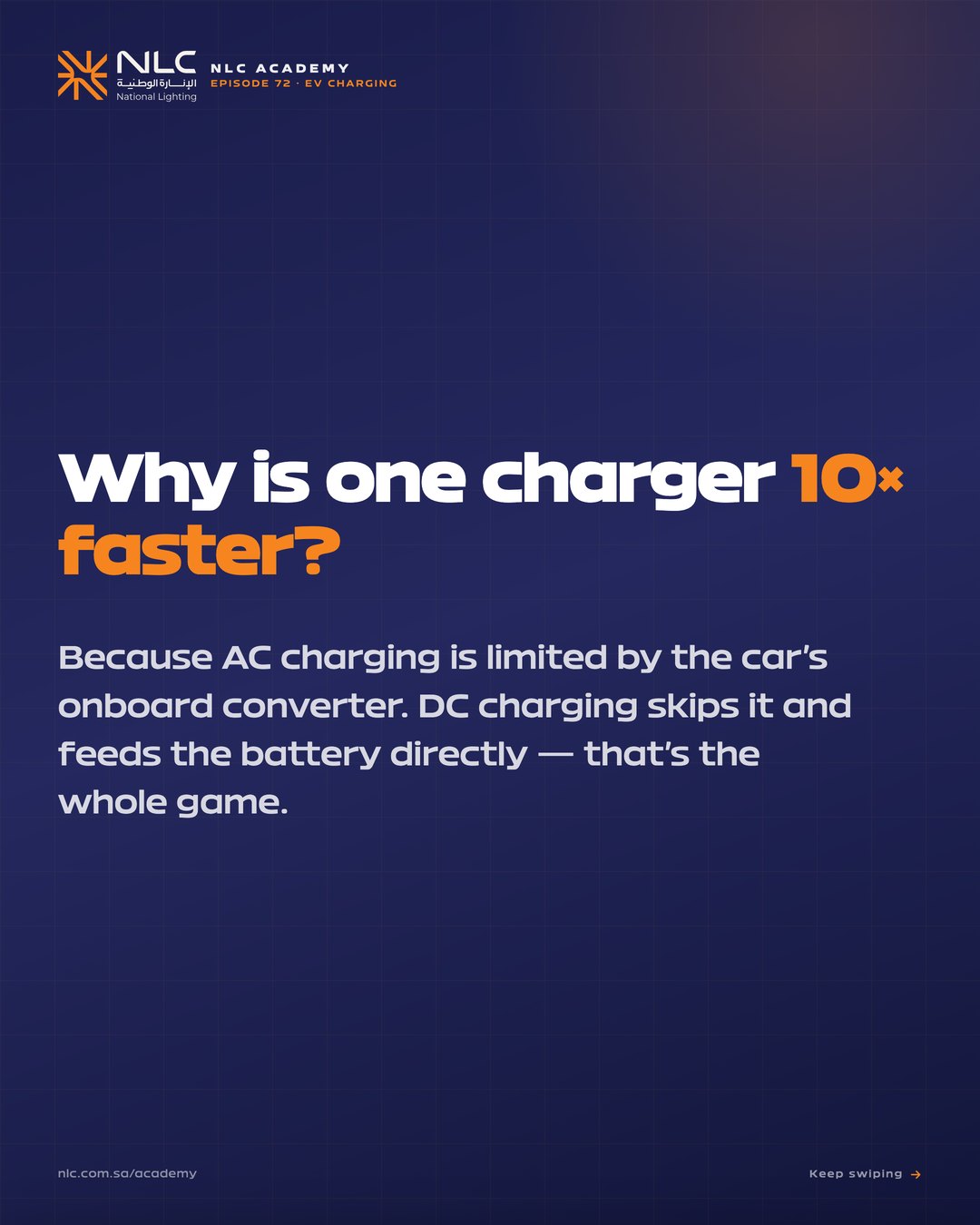
In AC charging, the car's onboard charger does the AC-to-DC conversion at low power (≤ 22 kW). In DC charging, the conversion is in the off-board charger; the connector hands the car ~400–800 V DC directly into the battery. This is why DC chargers cost 10× more than AC, the power electronics moved into the cabinet.

Connector standards have consolidated.

CCS Combo 2 (Europe / GCC), CCS Combo 1 (North America), CHAdeMO (legacy Japan, dying), GB/T (China), NACS / J3400 (Tesla, now opened). KSA EVIQ has standardised on CCS Combo 2 for new installations.

Load management is the design problem.

A 10-bay car park with 22 kW chargers needs 220 kW of contracted capacity if static. Or 75 kW with dynamic load management, the OCPP back-office monitors active sessions and reduces output per car when too many plug in. SEC contracts cost per peak kW, dynamic load management is the difference between a profitable site and a stranded asset.

ISO 15118 enables plug-and-charge.

The driver plugs in, the car and the charger exchange certificates, the session is authorised against the driver's account, no card or app needed. Adopted by VW Group, Ford, GM, BMW. For Saudi EVIQ super-hubs serving cross-border GCC traffic, ISO 15118 plug-and-charge is the user experience that justifies the price per kWh.

Saudi-specific thermal derating.

DC chargers at 50°C ambient cannot push full power continuously, the IGBT and cable thermals throttle. Specifications must include "rated output at 50°C ambient" not just "max output at 25°C." NLC outdoor enclosures provide sun shielding plus forced-air to keep DC chargers cool through KSA summer peaks.

Cable, connector, and inlet are wear items.

EV cables flex thousands of times per year. Connector pins are rated for ~10,000 mating cycles. Plan replacement at 5–7 years. The cheapest part of the asset, the cable, is the most operationally critical. A spec line "field-replaceable cable assembly" saves you from sending the entire charger back to the factory.

Forward the carousel to a colleague

A 10-slide explainer, ready to post straight to LinkedIn as an image carousel. Same content, faster reading.
Next Episode

Solar PV & Net-Metering KSA

Watch next

Get the next episode by email

Practical lighting know-how from NLC Academy. No spam, unsubscribe anytime.

By subscribing you agree to receive NLC emails.