Episode 122 ~2:25 Renewable Energy EN · العربية

Solar PV & net-metering, the Saudi small-scale stack

KSA gets 5–8 peak sun hours a day with the highest irradiance on Earth, and SEC's net-metering scheme lets buildings up to 1 MW push surplus back. A panel-string-inverter-meter chain converts photons to riyals on the bill. Here is what every part does and what KSA dust, heat, and tariff structure do to it.

Animated explainer, press play to watch the concepts now; the filmed cut publishes once production wraps.

What you'll walk away with

Four ideas that turn solar PV from a sales pitch into a spec.

01

STC numbers lie about KSA performance.

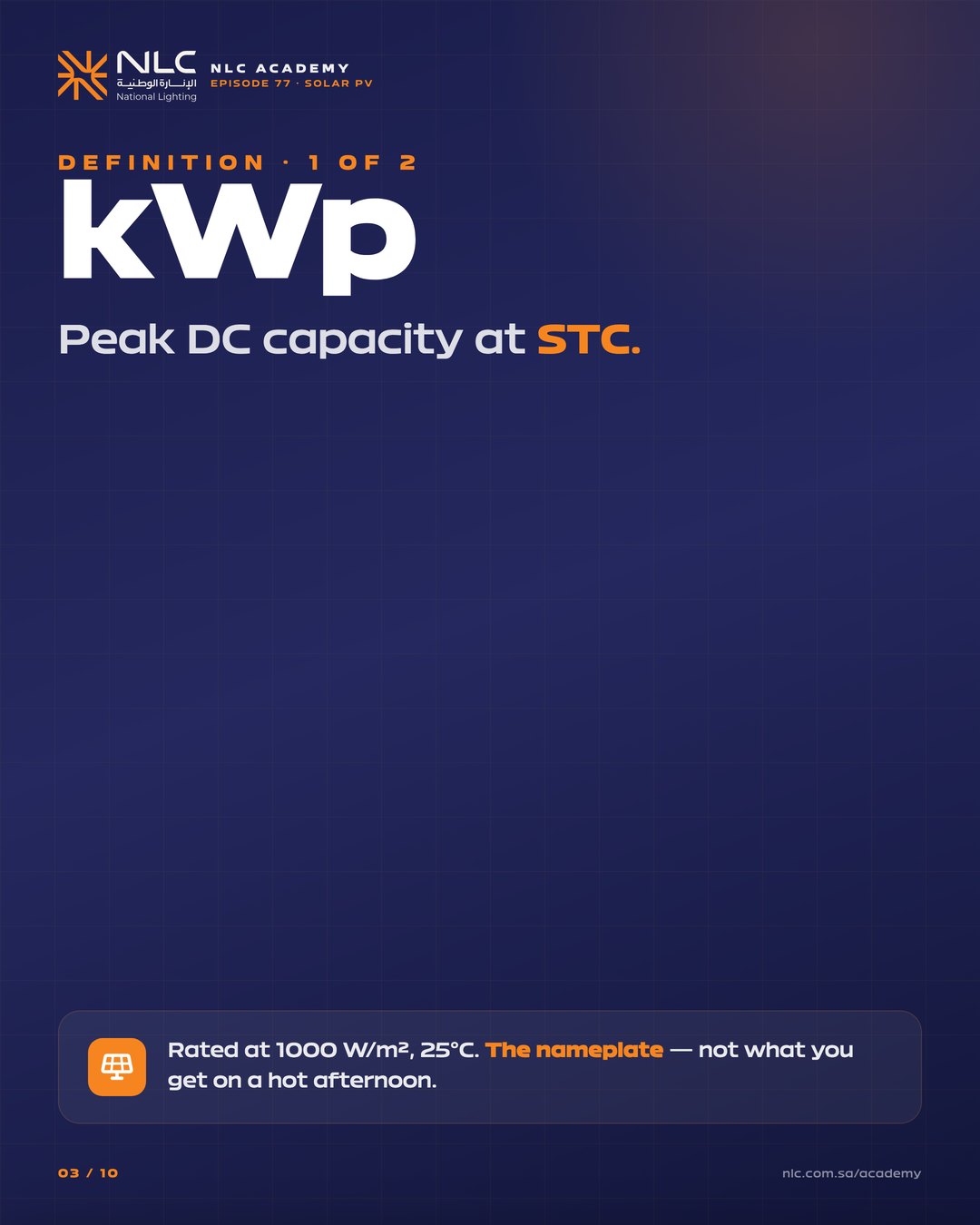
Panels are rated at 25°C. KSA roofs run 60–70°C. Each degree above 25 loses ≈ 0.4% efficiency. A 400 W panel delivers ~350 W in July, not 400.

02

Mono PERC has eaten the market.

Polycrystalline is legacy. Monocrystalline PERC (Passivated Emitter Rear Cell) and bifacial N-type TOPCon are the 2025 baseline. Higher efficiency, better high-temperature coefficient.

03

MPPT inverters are the brains.

Maximum Power Point Tracking keeps the panel string at peak power despite shading, temperature, and partial soiling. Multi-MPPT inverters (2–6 trackers) handle complex roof geometries.

04

SEC net-metering nets monthly, not instantly.

Surplus exported during the day offsets consumption at night, settled monthly. Unused export rolls 12 months. Cap: site load capacity, up to 1 MW small-scale, 2 MW commercial.

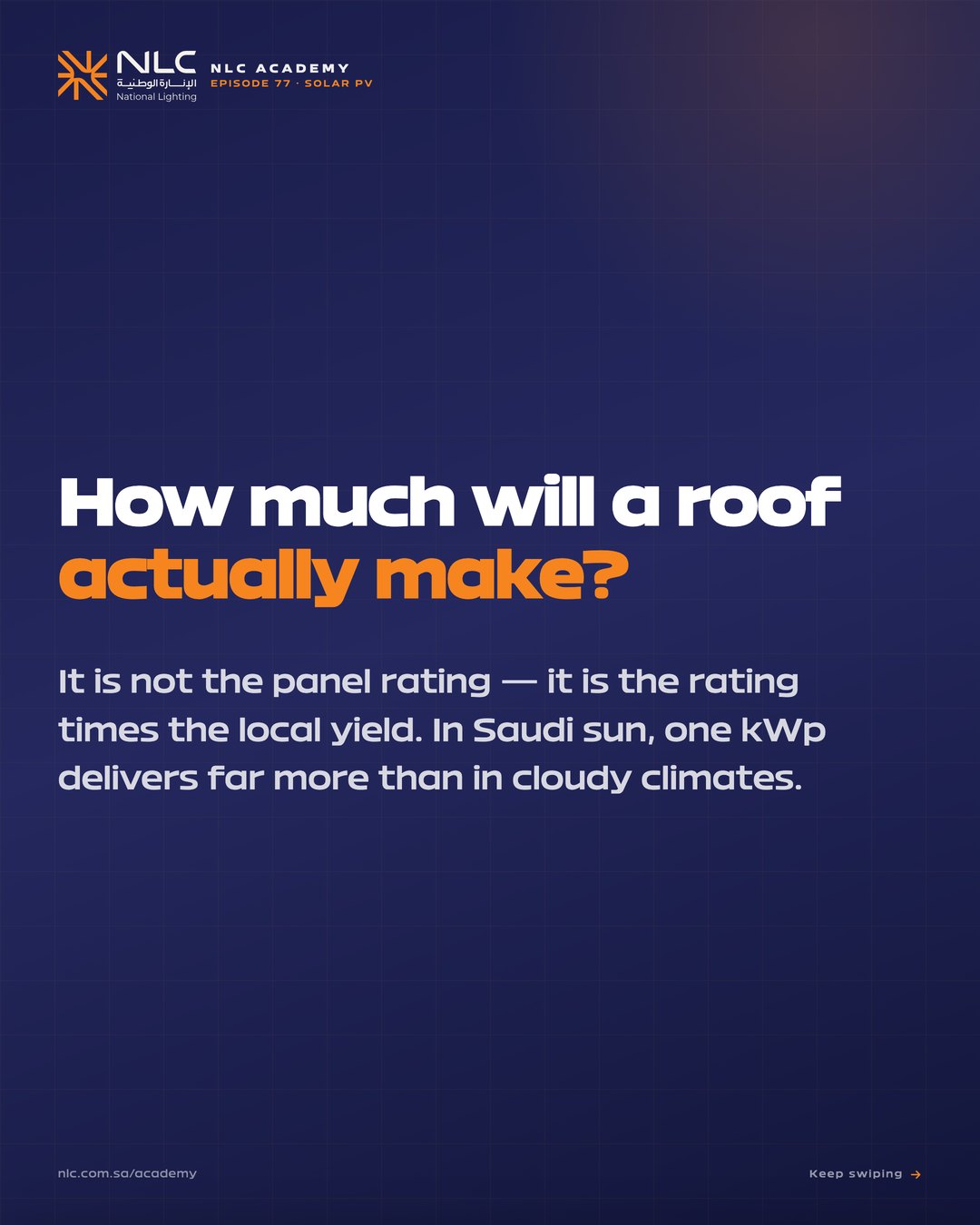
System size × area × output × payback (KSA)

Indicative residential / commercial, 5 PSH, KSA tariff 0.18 SAR/kWh weighted.

SystemRoof areaAnnual yieldAnnual savingSimple payback
5 kWp residential~30 m²~9,000 kWh~1,620 SAR7–9 years
10 kWp residential~60 m²~18,000 kWh~3,240 SAR6–8 years
50 kWp small commercial~300 m²~91,000 kWh~16,400 SAR5–7 years
200 kWp commercial~1,200 m²~365,000 kWh~66,000 SAR4–6 years
500 kWp light industrial~3,000 m²~912,000 kWh~164,000 SAR4–6 years
1 MW (net-metering cap)~6,000 m²~1,825 MWh~330,000 SAR4–5 years

How a Saudi PV system actually delivers

Six engineering decisions behind every grid-tied installation.

Mono PERC vs N-type TOPCon, the cell choice.

PERC has been the workhorse for a decade, 20–22% module efficiency. N-type TOPCon (Tunnel Oxide Passivated Contact) cells now exceed 23% and have a lower temperature coefficient (−0.30%/°C vs −0.35%/°C), critical in KSA summer. Bifacial TOPCon adds 5–15% from rear-side albedo, more on white-painted or sand-reflective roofs.

String vs micro inverter, the topology choice.

String inverters (10–125 kW) take one or two strings of series-connected panels into a single MPPT. Cost-efficient and reliable, but a shaded panel drops the whole string. Micro-inverters / DC optimisers per panel let each operate at its own MPPT, recovering 10–20% on roofs with partial shading or non-uniform orientation. Slightly higher cost, much better resilience.

SEC small-scale net-metering rules.

Eligible sites: ≤ 1 MW capacity, 1 MW small-scale, 2 MW commercial. Must not exceed contracted demand. Inverter must hold SEC anti-islanding certification (IEEE 1547, UL 1741, or VDE-AR-N 4105). Bi-directional smart meter installed by SEC. Application via SEC e-services portal. Monthly net settlement; surplus rolls 12 months; no cash payout for excess at year-end. Designed to incentivise self-consumption, not export trading.

Soiling losses are the KSA-specific surprise.

A clean panel in Riyadh delivers nominal. After 30 days without rain or cleaning, output drops 15–25% from dust accumulation. Cleaning schedules of 2–4 weeks are standard. Automated robotic cleaners and waterless brush systems (e.g. Ecoppia, NOMADD) pay for themselves at scale above ~500 kWp. The "soiling derate" is what makes or breaks the year-2 P&L on a KSA PV project.

Hybrid systems add battery storage.

For sites with critical loads, ARAMCO compounds, hospitals, telecom, a hybrid inverter with LiFePO4 battery storage (50–500 kWh) provides black-start, peak shaving, and time-of-use arbitrage. KSA is rolling toward time-of-use tariffs, and peak-period shaving can return a battery in 5–7 years even at small scale.

Performance Ratio is the audit number.

PR = actual energy output ÷ theoretical output. A well-designed Saudi system hits PR 78–82%. Below 75% indicates soiling, shading, or inverter clipping; above 85% is unrealistic for KSA ambient. Every NLC PV proposal includes a 12-month PR guarantee, the contractual evidence that the system performs to the model.

Forward the carousel to a colleague

A 10-slide explainer, ready to post straight to LinkedIn as an image carousel. Same content, faster reading.
Back to

All Episodes

All episodes

Get the next episode by email

Practical lighting know-how from NLC Academy. No spam, unsubscribe anytime.

By subscribing you agree to receive NLC emails.