Episode 5 ~1:50 Hardware EN · العربية

Choosing the right reflector for the beam you actually need

Two fixtures with identical lumen output can read 400 lux or 90 lux on the same floor, the reflector is doing the work. Here is how to read a beam-angle spec, and what mounting height does to it.

Animated explainer, press play to watch the concepts now; the filmed cut publishes once production wraps.

What you'll walk away with

Four ideas to carry into the next specification conversation you have.

01

Narrow beams travel. Wide beams spread.

A 15° spot pushes lumens far down with minimum spill. A 60° flood lights a wider area at lower intensity. Choose for the task, not the fixture catalogue.

02

Coverage radius scales with mounting height.

At 6 m a 60° beam covers ≈ 7 m diameter on the floor. Double the height, quadruple the area, quarter the lux.

03

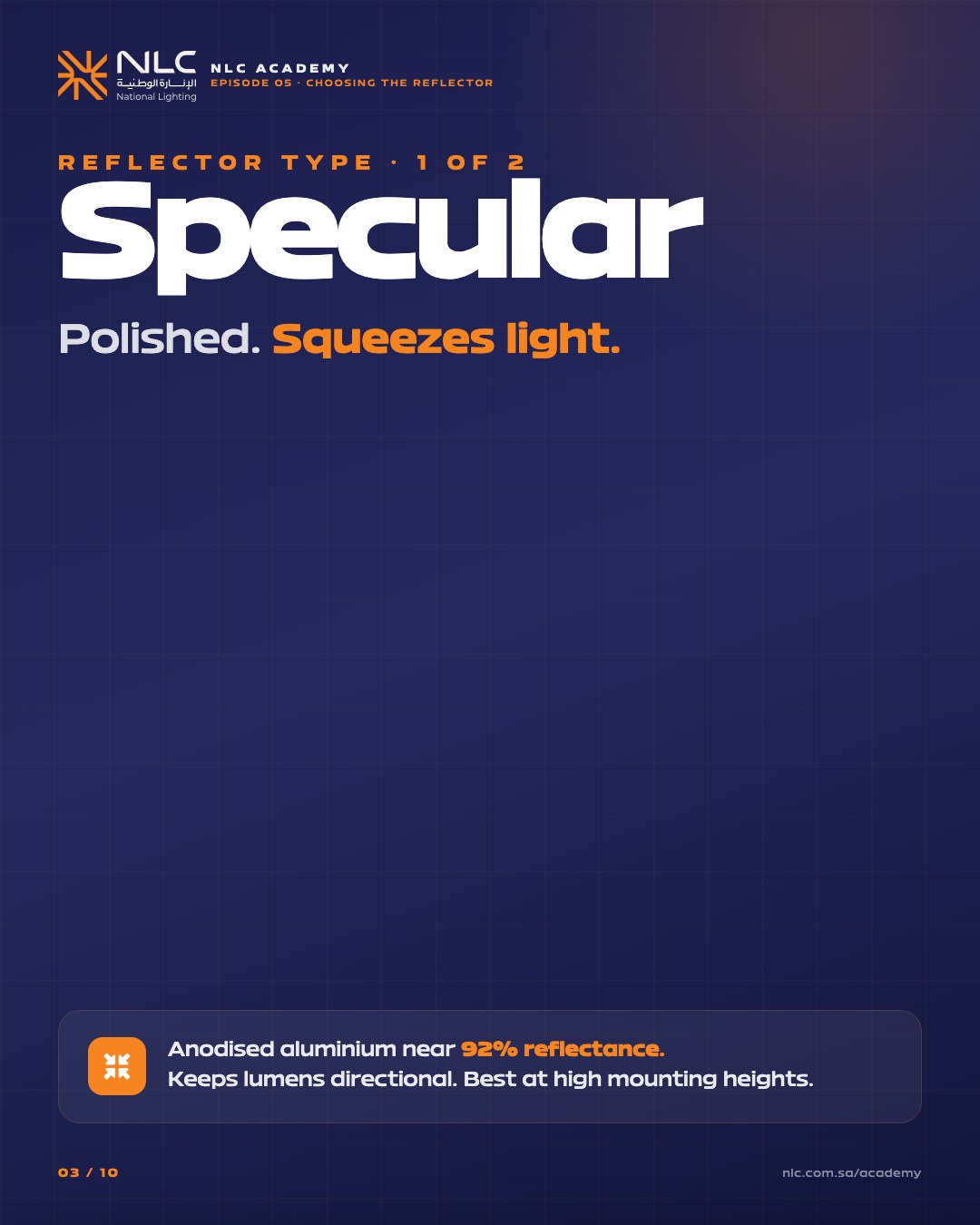
Specular vs diffuse changes glare, not lumens.

A polished aluminium reflector preserves intensity but raises UGR. A matte white reflector softens, at a small efficacy cost.

04

Match the reflector to the visual task.

Aisles want wide-flood. Display want narrow-spot. Offices want batwing. The reflector is a design decision, not a cosmetic one.

Beam angle × mounting height, coverage on the floor

Approximate diameter of the lit circle, assuming a circular beam. Real fixtures use IES files for accuracy.

Beam angle Coverage @ 3 m / 6 m / 9 m Typical use
10° (narrow spot)0.5 / 1.0 / 1.6 mFaçade accent · merchandise
24° (spot)1.3 / 2.6 / 3.8 mRetail downlight · gallery
36° (medium)2.0 / 3.9 / 5.8 mOffice downlight
60° (flood)3.5 / 6.9 / 10.4 mGeneral lighting · corridors
90° (wide flood)6.0 / 12.0 / 18.0 mWarehouse aisles
120° (batwing)10+ m (lateral spread)Office desks · classrooms

How a reflector shapes light

Six ideas that change how you read a photometric distribution.

Beam angle is measured at 50% intensity.

When a spec sheet lists "36° beam," that is the half-angle at which luminous intensity falls to half of peak (FWHM). Outside that, you still get spill, typically the "field angle" at 10% peak is 30–50% wider. Plan for both.

Specular reflectors squeeze, diffuse reflectors share.

An anodised aluminium reflector with 92% specular reflectance keeps lumens directional, great for high mounting heights. A matte white powder-coated reflector at 80% diffuse reflectance loses some intensity but reduces glare on near-vertical sightlines.

Photometric distribution beats marketing diagrams.

A real IES/LDT file tells you intensity in candela at every angle. A glossy brochure showing a clean cone is marketing. Always ask for the photometric file before specifying.

Mounting height is half the design.

Lux at the work plane drops with the square of distance. A 30,000 cd fixture gives ≈ 3,300 lux at 3 m and ≈ 830 lux at 6 m on the beam axis. Halving the height does not halve the lux, it quadruples it.

Reflector + lens together = the optical system.

Modern LED fixtures combine a primary reflector around the chip with a secondary lens or refractor on the aperture. The reflector decides spread; the lens decides cut-off and glare control. Specify the system, not just the angle.

Reflector colour controls glare. Black absorbs, white reflects.

Light-coloured reflectors bounce stray light around the housing and lift total lumen output, but the cup itself reads bright on the sightline. A matte-black reflector absorbs that internal scatter instead of re-emitting it, lowering the fixture's apparent brightness without touching the beam aimed at the work plane, the practical UGR drop is typically 2–4 points. Reach for black in meeting rooms, classrooms, control rooms, museums, and high-end retail where contrast matters. A large portion of NLC's office downlights and recessed luminaires (LUXO, ICON, AGILE, HANDY, MINI, CYLINDER, and more) ships with white, mirror-silver, and matte-black reflector options as a build-to-order choice, specify the colour against the lumen/glare balance the room needs.

Next Episode

What is IP?

Watch next

Forward the carousel to a colleague

A 10-slide explainer, ready to post straight to LinkedIn as an image carousel. Same content, faster reading.
Get the next episode by email

Practical lighting know-how from NLC Academy. No spam, unsubscribe anytime.

By subscribing you agree to receive NLC emails.