Episode 113 ~2:20 Outdoor Lighting EN · العربية

Roadway lighting classes, EN 13201 in practice

SEC, NEOM, and every Saudi municipality brief starts the same way: pick the lighting class. M for motor traffic, P for pedestrian, C for conflict zones. Each class fixes the luminance, uniformity, glare, and surround ratio the road must hit. Here is how to read it.

Animated explainer, press play to watch the concepts now; the filmed cut publishes once production wraps.

What you'll walk away with

Four ideas that close every "what lux on this street?" conversation in one sentence.

01

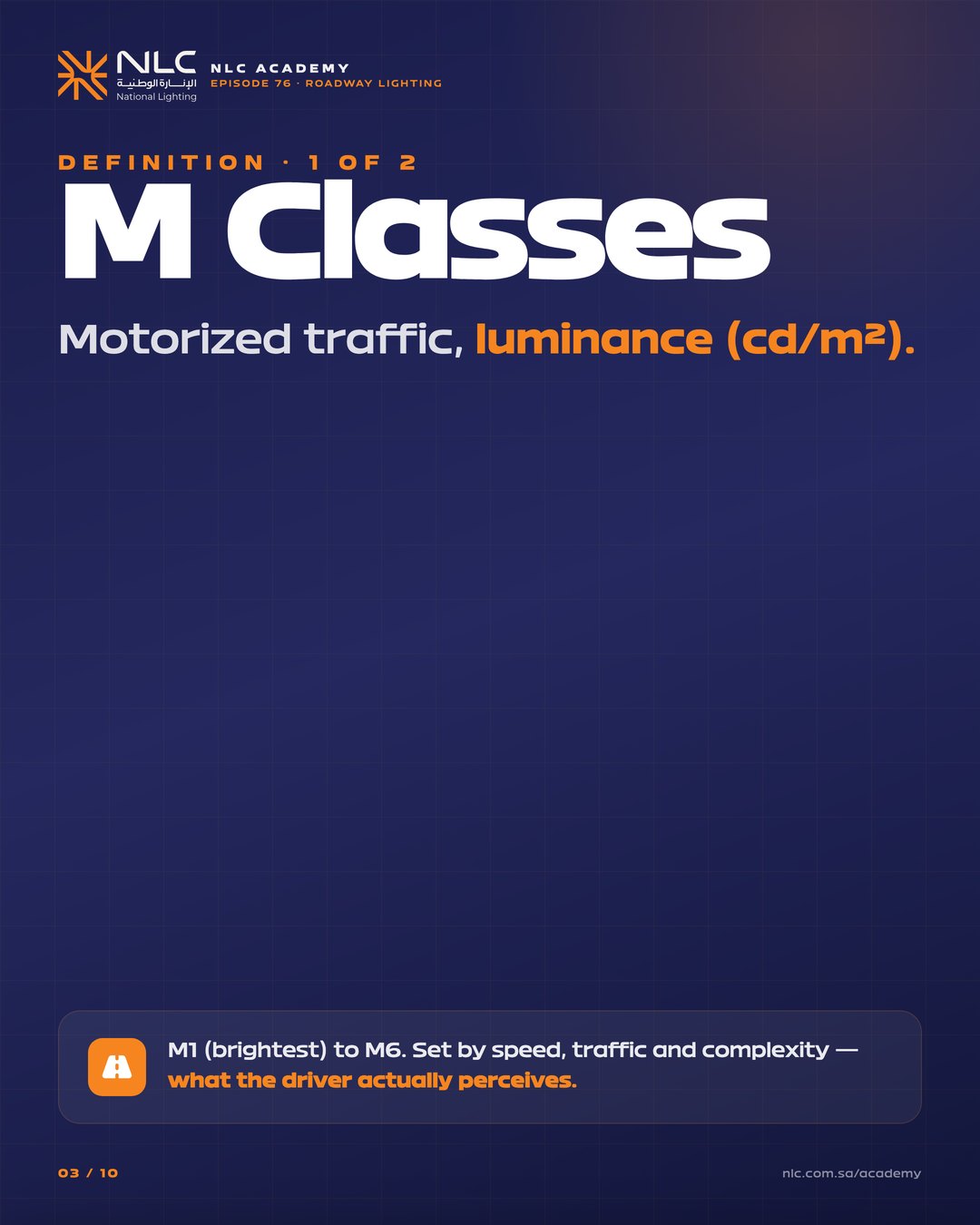
Motor traffic is measured in cd/m², not lux.

M-class is luminance on the road surface, what the driver actually sees. P and C classes use lux. Mixing the two is the most common spec-sheet error.

02

Uniformity matters as much as average.

U0 ≥ 0.4 means the darkest point is at least 40% of the mean. A street with 1 cd/m² average and 0.1 worst-point fails M3 even if the lamp lumens are correct.

03

Glare gets its own number: TI.

Threshold Increment caps disability glare to drivers. M-classes hold TI ≤ 10–15%. Pedestrian classes use UGR-O or stick with G ratings.

04

Surrounding ratio (SR) is half the design.

SR ≥ 0.5 means the road's bordering strip is ≥ 50% as bright as the carriageway. Skip it and the driver's peripheral vision goes dark, fatigue rises, accidents follow.

Class × luminance × uniformity × glare

Headline values per EN 13201-2. Real selection uses Part 1 traffic flow tables.

ClassAvg luminance / luxUniformity U0GlareTypical road
M12.0 cd/m²0.4TI ≤ 10%Motorway, high speed
M21.5 cd/m²0.4TI ≤ 10%Expressway
M31.0 cd/m²0.4TI ≤ 15%Urban arterial
M40.75 cd/m²0.4TI ≤ 15%Collector road
P37.5 lux0.4G ≥ 4Pedestrian high-use
C315 lux0.4Roundabouts · junctions

How EN 13201 actually picks a class

Six steps from a traffic survey to a fixture spec.

Start from Part 1, not Part 2.

EN 13201-1 is the selection guide. It asks: traffic flow (vehicles/hour), composition (heavy vs light), speed, separation of road users, junction density, and ambient luminance. The answers map to M-class number. Going straight to Part 2 lux tables without doing the Part 1 worksheet is how consultants end up over-lighting half the city.

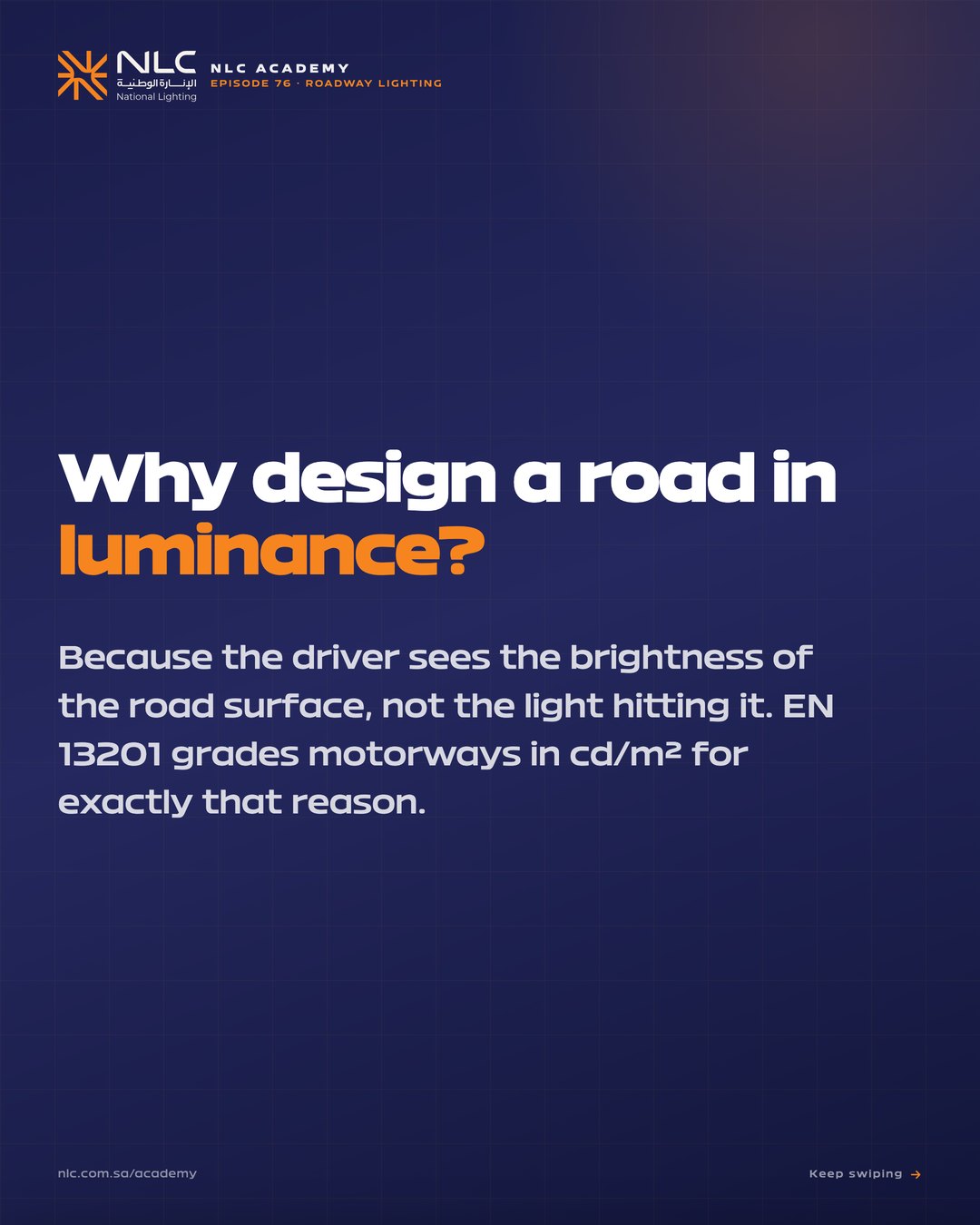
M-class measures the road, not the air above it.

Drivers see luminance, light reflecting off the road surface toward the eye, not the lux landing on the asphalt. The same lux gives very different luminance on dry concrete vs wet asphalt vs new tarmac. EN 13201-3 specifies the R-table (R1-R4) of the surface, and your DIALux/AGi32 model has to match the actual road.

P-class is the pedestrian's perspective.

On footpaths, residential streets, parks, and pedestrian crossings, the eye is looking at faces and obstacles, not the road surface. EN 13201 switches from cd/m² luminance to horizontal and semi-cylindrical illuminance, lux that lands on a 1.5 m vertical face at eye level. P-classes also tighten minimum lux, not just average, so dark corners cannot hide.

C-class is for conflict areas.

Roundabouts, complex junctions, pedestrian crossings, and toll plazas mix vehicles, pedestrians, cyclists, and stopped traffic. EN 13201 dropped the old CE-class and now uses C0-C5 with horizontal lux targets, higher than the connecting M-class so drivers' eyes adapt before decision points.

Glare is restricted by TI, not UGR.

Threshold Increment is the % increase in roadway luminance the driver would need to see the same object once the luminaire is in view. M1-M2 caps TI at 10%, M3-M6 at 15%. House-side shielding, post-top fixtures with full cut-off, and TIR optics with sharp 70°+ cut-off are how this gets met without dropping street-side lux.

Surrounding Ratio = half the safety story.

EN 13201 added SR (Surrounding Ratio) explicitly: the average illuminance on a 5 m strip beside the carriageway must be ≥ 0.5 of the carriageway luminance. This is what stops the "tunnel-vision" effect drivers feel on under-lit Saudi service roads, where the carriageway is bright but the verge disappears into black, and a pedestrian stepping off the kerb becomes invisible.

Forward the carousel to a colleague

A 10-slide explainer, ready to post straight to LinkedIn as an image carousel. Same content, faster reading.
Next Episode

Tunnel Lighting Zones

Watch next

Get the next episode by email

Practical lighting know-how from NLC Academy. No spam, unsubscribe anytime.

By subscribing you agree to receive NLC emails.