Episode 8 ~2:00 Design EN · العربية

Kelvin, and why colour temperature matters more than people think

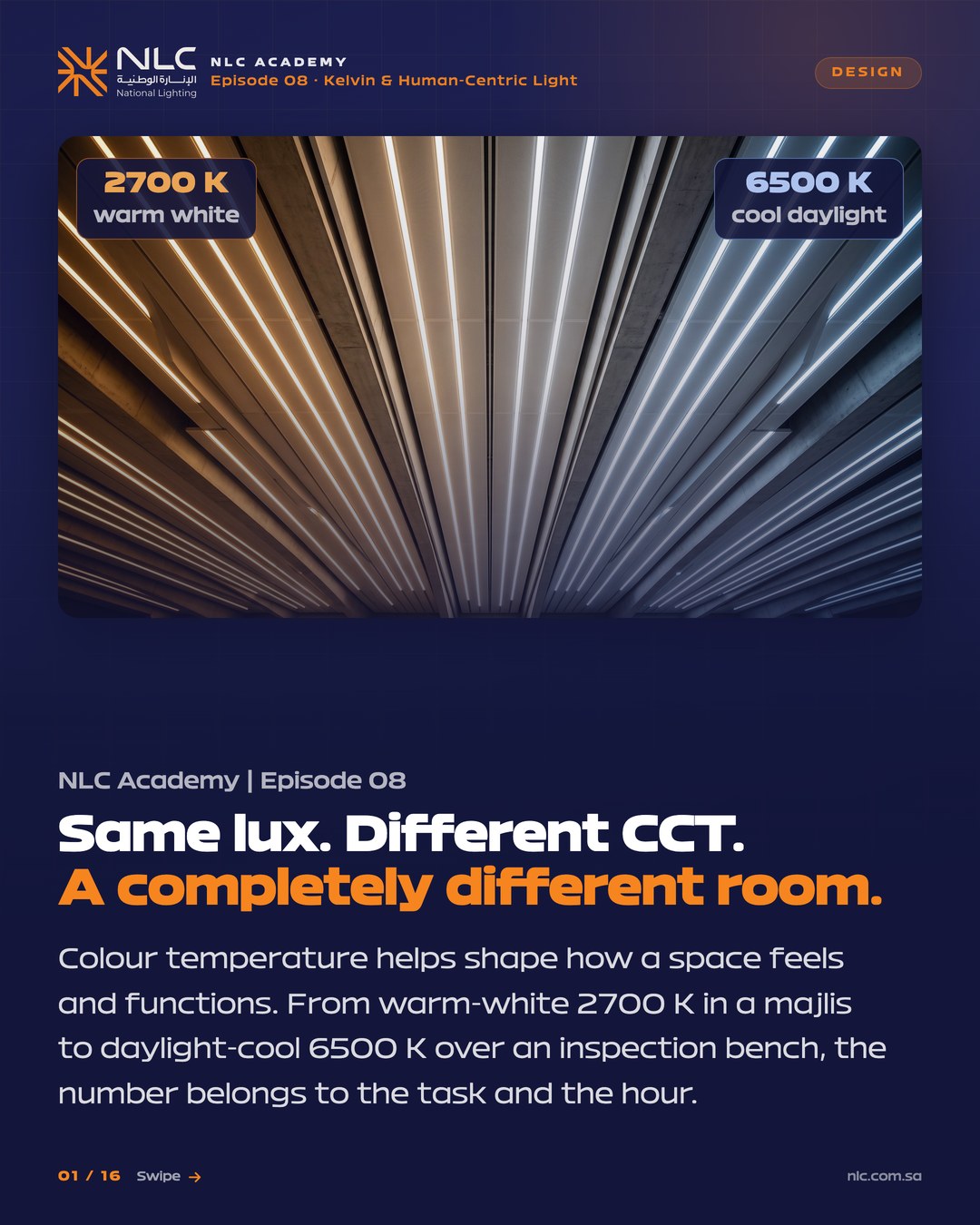
Light isn't just bright, it has a temperature. From the candle-warm 2700 K of a hotel lobby to the noon-cold 6500 K of an operating theatre, CCT decides whether a room wakes you up or winds you down.

Animated explainer, press play to watch the concepts now; the filmed cut publishes once production wraps.

What you'll walk away with

Four ideas to carry into the next specification conversation you have.

01

CCT measures the colour of white.

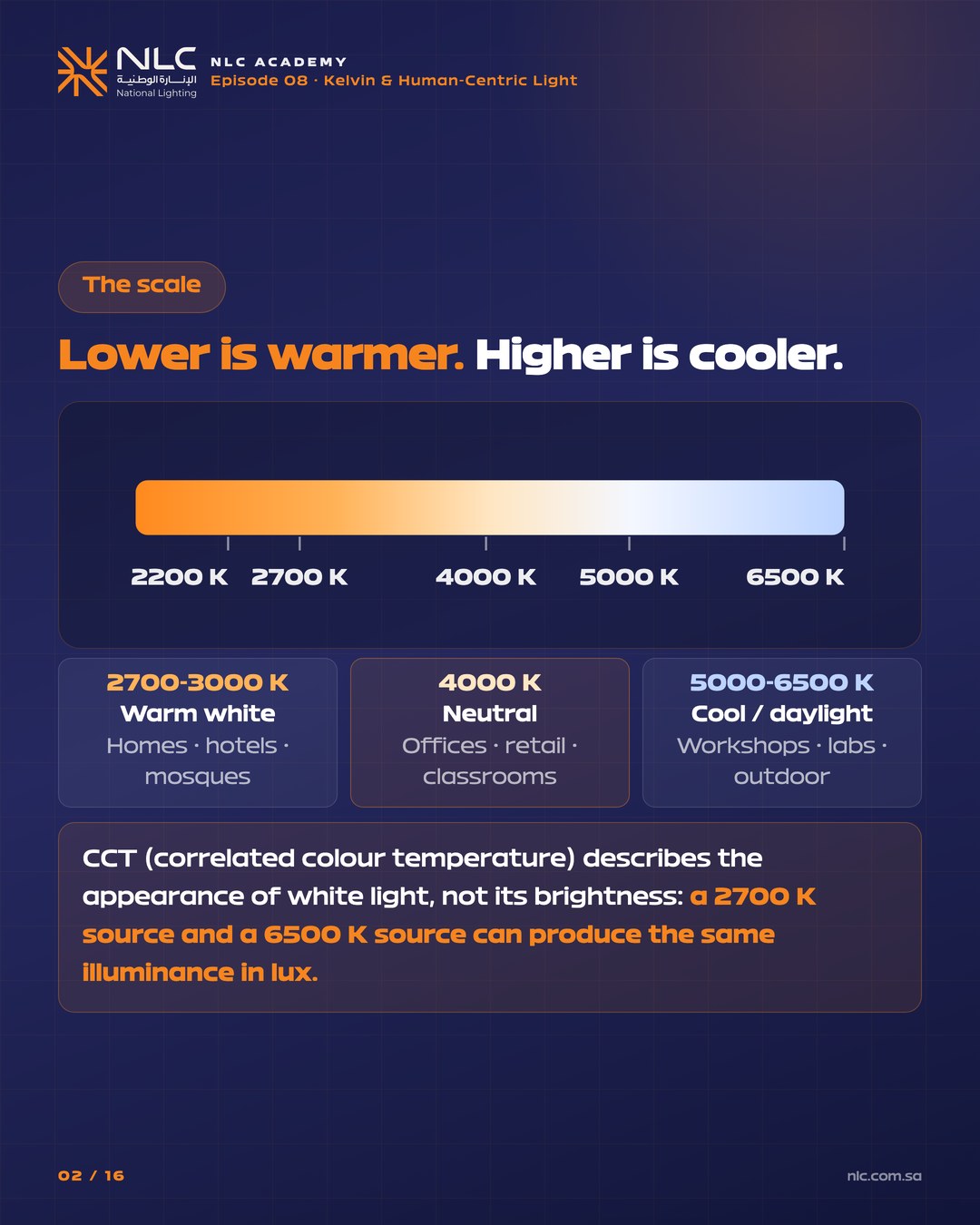
Correlated Colour Temperature in Kelvin. Lower numbers = warmer (yellow/red). Higher = cooler (blue/white).

02

Saudi default: warm for residential, neutral for retail.

2700–3000 K for homes and hotels. 4000 K for offices and retail. 5000–5700 K for hospitals, workshops, and outdoor.

03

Cool light suppresses melatonin.

Blue-rich 5000 K+ in the evening signals "daytime" to the brain. Use sparingly after sunset in spaces people sleep in.

04

Tunable white is the new default for premium.

A fixture that shifts 2700 K → 6500 K through the day mimics natural cycles. Common in hospitals, increasingly in offices.

CCT × space × time of day

Recommendations align with WELL Building Standard L03 and BS EN 12464-1 Annex A.

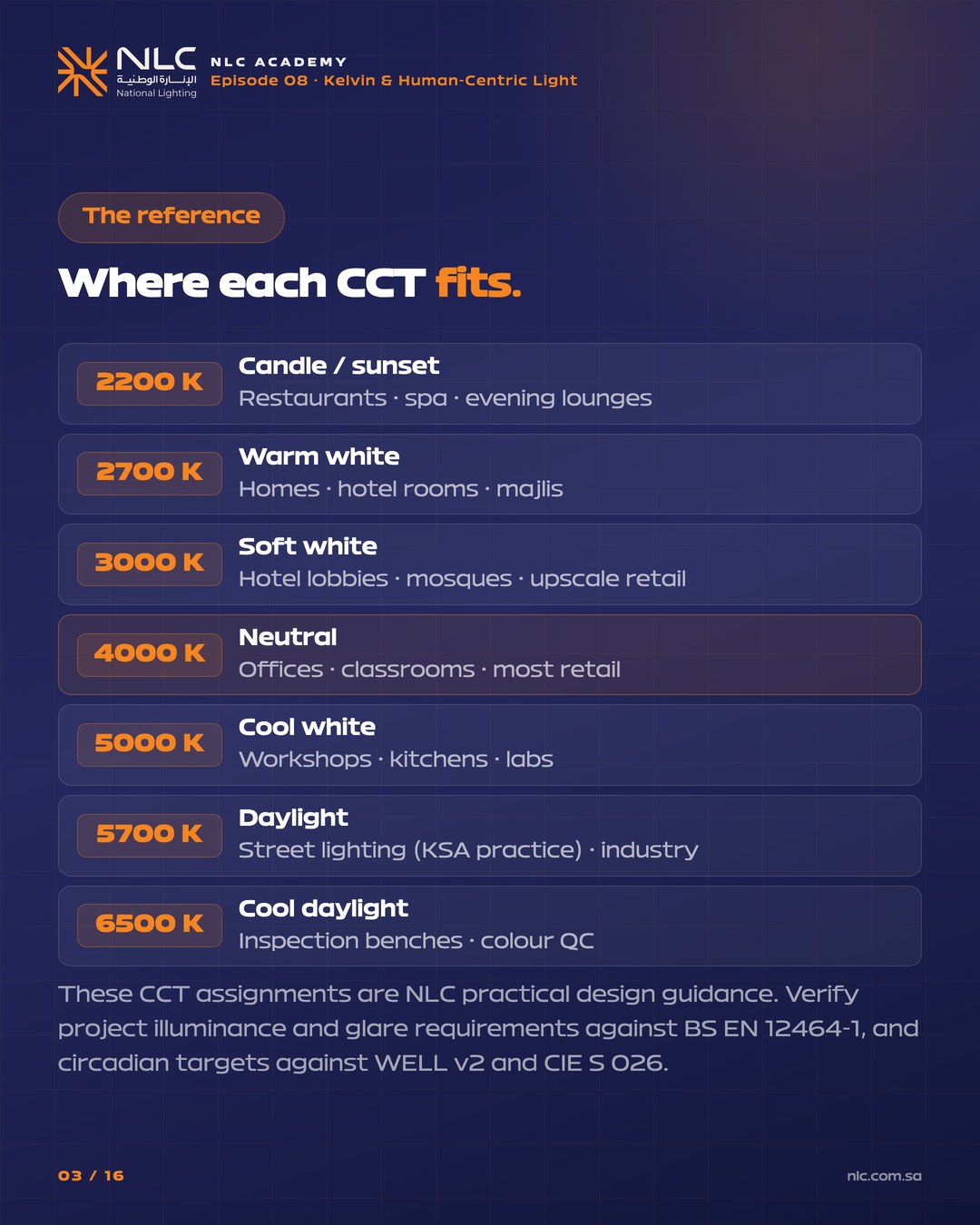
CCT Mood Where it belongs
2200 KCandle / sunsetRestaurants · spa · evening lounges
2700 KWarm whiteHomes · hotel rooms · majlis
3000 KSoft whiteHotel lobbies · upscale retail
3500 KNeutral warmMid-range retail · gym
4000 KNeutralOffices · classrooms · most retail
5000 KCool whiteWorkshops · kitchens · labs
5700 KDaylightStreetlight · outdoor · industry
6500 KCool daylightOperating theatres · inspection

From Kelvin to circadian, what to actually do

Five facts that turn CCT from a number on a box into a design decision.

CCT is correlated, not exact.

Correlated Colour Temperature describes the closest match on the Planckian (black-body) locus. Two fixtures both labelled "4000 K" can sit on opposite sides of the locus, one slightly green, one slightly magenta. The Duv value (see episode 11) decides which.

Melanopic lux > photopic lux for circadian effect.

Old design used photopic lux (what your cones see). Modern human-centric design uses melanopic-equivalent daylight (D65) illuminance, what your ipRGC cells see. 5000 K+ has roughly 2× the melanopic content of 2700 K at the same lux.

The 21st-century office runs at 4000 K, not 6500 K.

A decade ago, daylight (6500 K) was treated as the gold standard. Research since (Lighting Research Centre, 2018+) shows 4000 K matches alertness without melatonin disruption. 6500 K is over-correction unless paired with strict dim-down after 5 pm.

Mosque and residential design defaults to 3000 K.

In the Gulf market, warm white is the cultural default. Saudi villas, majlis, hotel lobbies, mosques, all assume 2700–3000 K. Spec 4000 K only where the task demands it (kitchens, garages, offices).

Tunable white needs a control protocol.

A 2700-6500 K tunable fixture is just a fixture until DALI Type 8 or 0-10 V dual-channel drives it. Without controls, you bought a fixture that does one thing well. With controls, you bought a system.

Next Episode

Lenses vs Barn Doors

Watch next

Get the next episode by email

Practical lighting know-how from NLC Academy. No spam, unsubscribe anytime.

By subscribing you agree to receive NLC emails.