Episode 119 ~2:20 LV Distribution EN · العربية

Earthing systems, TN, TT, and IT explained

Three letters that decide whether a fault clears in 5 ms or burns through a panel. TN-S, TN-C, TN-C-S, TT, and IT, each is a different choice about where the source neutral goes, where exposed metal goes, and what type of protection will actually trip when something goes wrong.

Animated explainer, press play to watch the concepts now; the filmed cut publishes once production wraps.

What you'll walk away with

Four ideas that pick the right earthing system for every Saudi installation.

01

First letter = source. Second = load.

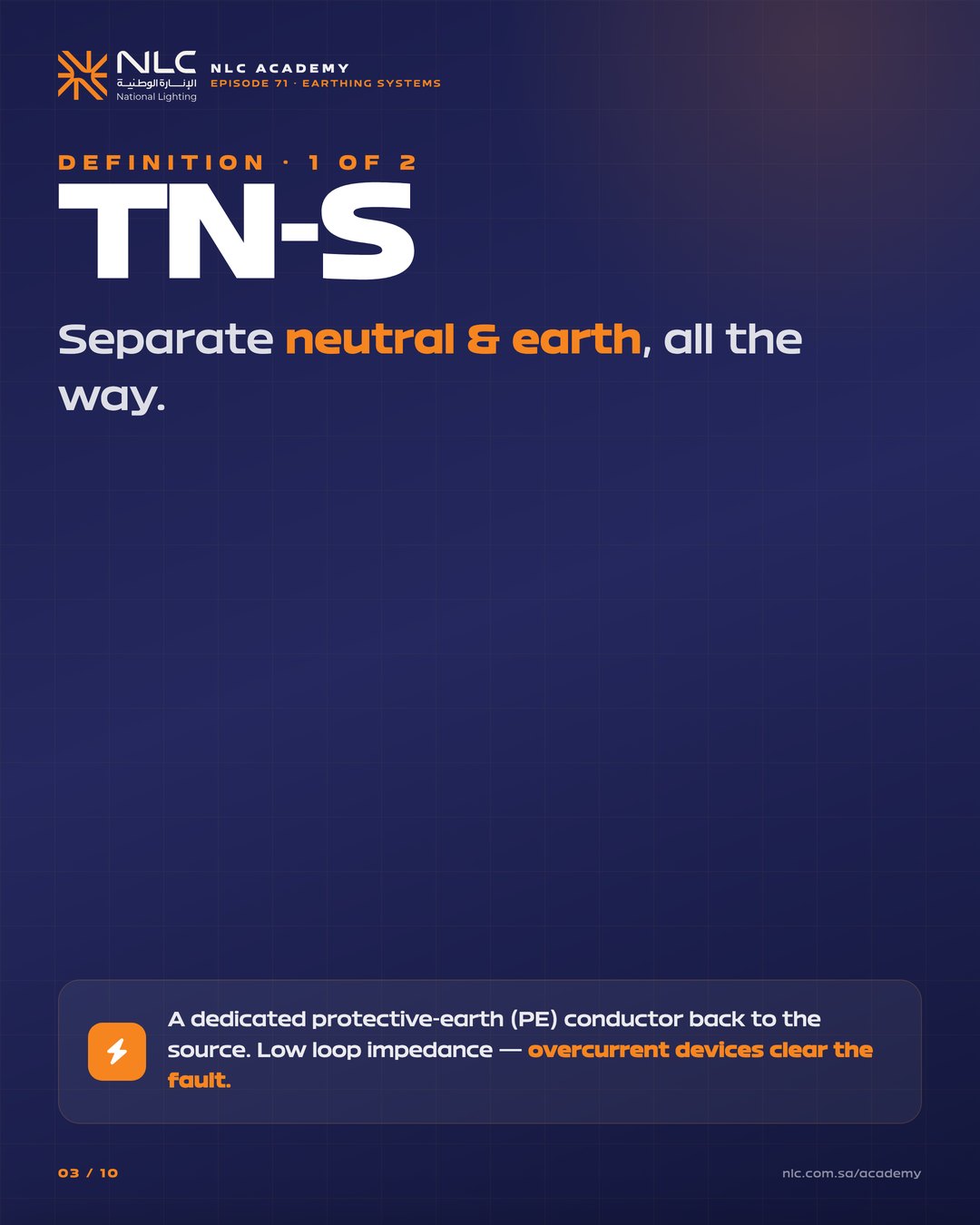
T = direct to earth. N = via neutral. TN means source-to-earth, load-via-neutral. TT means source-to-earth, load-direct-to-earth. IT means source isolated, load to earth.

02

TN-S is what KSA uses by default.

SEC supply gives a separate PE conductor from the transformer all the way to the panel. Cleanest fault path, easiest protection coordination. Choose this unless there is a specific reason to deviate.

03

TT needs RCDs, not just MCBs.

If neutral and earth meet only at the source, fault impedance through soil is too high for overcurrent protection. 30 mA RCD is mandatory for personal protection, 300 mA RCD for fire.

04

IT keeps running on first fault.

An isolated system with high-impedance neutral can survive a single earth fault without tripping, the IMD alarms instead. Mandatory in operating theatres (medical IT) and continuous-process industry.

System × neutral × protection × use

IEC 60364-4-41. KSA SBC 401 references the same.

SystemSourceLoadRequired protectionTypical use
TN-SSource earthedSeparate PE + NOvercurrent + optional RCDKSA new-build default
TN-CSource earthedCombined PENOvercurrent onlyPre-1990 installations
TN-C-SSource earthedPEN to entry, then PE+NOvercurrent + RCDSEC supply riser
TTSource earthedLoad to local earthRCD mandatoryRural / standalone generator
ITSource isolated / ZLoad to earthInsulation Monitor (IMD)Hospital OT · continuous process
Medical ITIsolating transformerLoad to equipotential busIMD + isolationHospital operating theatre

How an earthing system actually works

Six engineering decisions behind every system grounding choice.

Earth fault loop impedance is the key.

Zs (loop impedance from live, through the fault, back to source) sets the prospective fault current. TN-S has a low Zs (metallic path), giving thousands of amps and instant MCB trip. TT has Zs limited by soil resistivity, fault currents may be ≤ 50 A, not enough to operate any MCB but plenty to electrocute. This is why TT installations need an RCD.

PEN reduces material, raises risk.

TN-C combines protective earth and neutral in a single PEN conductor. Saves a cable run. But a broken PEN puts full line voltage on every exposed metal surface in the building. IEC 60364 now bans TN-C inside buildings; combined PEN is only allowed in the supply riser up to the main earth bar (TN-C-S).

RCD doesn't sense overcurrent, it senses imbalance.

A residual current device measures the difference between live and neutral currents in real time. Normal load: difference is zero. Fault to earth: current leaves via PE, imbalance appears, RCD trips in 30–40 ms. RCDs work on TN, TT, and IT systems, not just TT, but on TT they are non-negotiable because the MCB alone cannot clear earth faults.

Medical IT keeps the surgeon working.

In a TN system, a first earth fault on a surgical lamp trips the breaker, the theatre goes dark mid-operation. In medical IT, the same fault is harmless, IMD alarms but power flows; the team finishes the operation, then maintenance investigates. IEC 60364-7-710 mandates IT for Group 2 medical locations.

Surge protection coordination depends on the system.

Type 1 SPDs upstream of the main panel reference earth differently in TN-S vs TN-C-S vs TT. Wrong selection means surge currents flow in unintended paths. The SPD vendor data-sheet always lists earthing-system compatibility, read it.

Equipotential bonding is part of every system.

Whatever earthing system you pick, every exposed conductive part (pipes, ducts, structural metal, BMS cabinets, IT racks) must be bonded to the main earth bar. This is what stops fault voltage gradients across the floor of a building and the touch-voltage they create. Main equipotential bond at the service entry, supplementary bonds in bathrooms / kitchens / wet rooms, mandatory under SBC 401.

Forward the carousel to a colleague

A 10-slide explainer, ready to post straight to LinkedIn as an image carousel. Same content, faster reading.
Next Episode

Lightning Protection (IEC 62305)

Watch next

Get the next episode by email

Practical lighting know-how from NLC Academy. No spam, unsubscribe anytime.

By subscribing you agree to receive NLC emails.